
The Moritz Grossmann Tefnut 36 Silver-Plated by Friction Turquoise Blue is the fifth — and most intimate — anniversary model in Glashütte's most meticulous 200th-birthday programme. Following the Hamatic, the Tremblage, the Tefnut and the Backpage Tremblage, the brand honours its founder with yet another anniversary gift. Once again, a model from the elegant Tefnut dress watch line has been selected, this time in a smaller 36mm case, with a dial created using the traditional art of silver-plating by friction, highlighted with lovely turquoise accents for a more contemporary touch. Limited to 12 pieces in stainless steel, the Moritz Grossmann Tefnut 36 Silver-Plated by Friction Turquoise Blue is priced at EUR 29,000 excluding VAT. It is, by any measure, a collector's piece rather than a commercial release — and it makes no apology for that.
For more from Moritz Grossmann's collection, see our German watch archive and our independent watchmaking guide. Here is everything worth knowing.
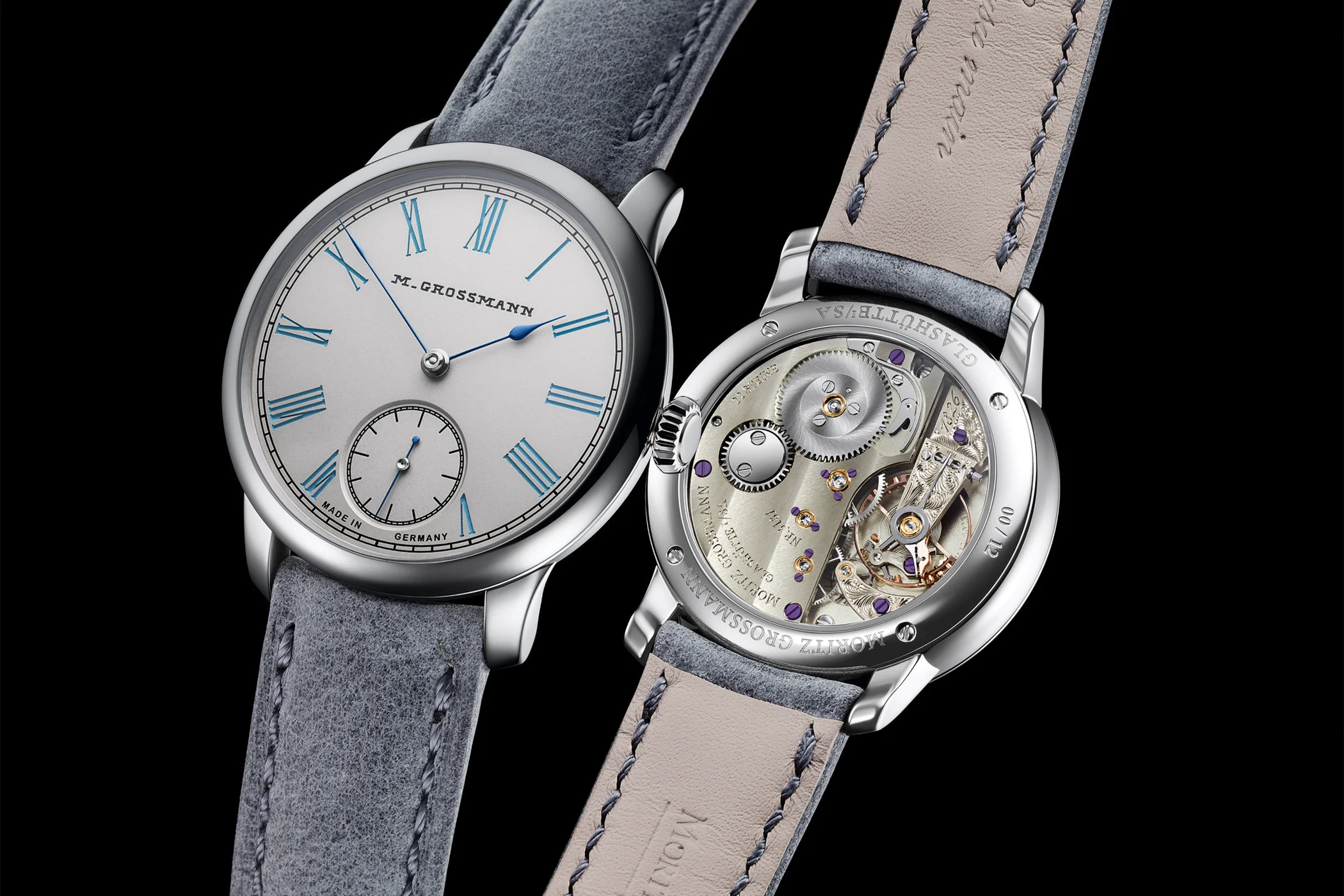
Moritz Grossmann Tefnut 36 Silver-Plated by Friction Turquoise Blue, ref. MG-004153. Image: © Moritz Grossmann via Monochrome Watches
Who Was Carl Moritz Grossmann?
The 200th anniversary the Moritz Grossmann Tefnut 36 celebrates is not the company's founding — it is the birthday of a man. Carl Moritz Grossmann was born on March 27, 1826, in Dresden, Germany. He was persuaded by his friend Ferdinand Adolph Lange to establish a mechanical workshop in Glashütte. He gained fame for his specialised watchmaking tools, pocket watches, marine chronometers and precision pendulum clocks, and was also a co-founder of the German School of Watchmaking.
The connection to Ferdinand Adolph Lange is significant. Lange founded the firm that became A. Lange & Söhne — today one of the most celebrated names in German watchmaking. Grossmann was not merely Lange's neighbour; he was his contemporary and collaborator in making Glashütte the watchmaking centre it became. Grossmann died in 1885, and his firm ceased production with him. In 2008, Christine Hutter — a trained watchmaker with a background at Glashütte Original and A. Lange & Söhne — acquired the dormant Moritz Grossmann name and revived it with an emphasis on high-end Saxon watchmaking and in-house production. The Grossmann micrometer screw, visible on the balance cock of every Moritz Grossmann movement, is a direct technical legacy from the founder himself.
What Is the Moritz Grossmann Tefnut 36?
The Moritz Grossmann Tefnut 36 is a 36mm version of the Tefnut — the brand's flagship dress watch, named for the ancient Egyptian deity of moisture and air, and the thinnest model in the Moritz Grossmann lineup. As the brand's embodiment of understated elegance, the Tefnut dress watch line has the thinnest profiles. A delightfully compact watch, the case of this anniversary Tefnut has a 36mm diameter and a slim height of 8.5mm. Entirely polished, the case has gently tapered lugs and a large, easy-to-grip flat winding crown.
The 36mm is smaller than the standard Tefnut (39mm) that appeared in earlier 2023 and 2026 silver-plated editions. This size choice matters: it brings the watch closer to the proportions of the 19th-century pocket watches and early wristwatches that Grossmann himself would have produced, and it positions the Moritz Grossmann Tefnut 36 as a piece that reads on the wrist the way a precision instrument should — present but unobtrusive, with all its interest in the details.
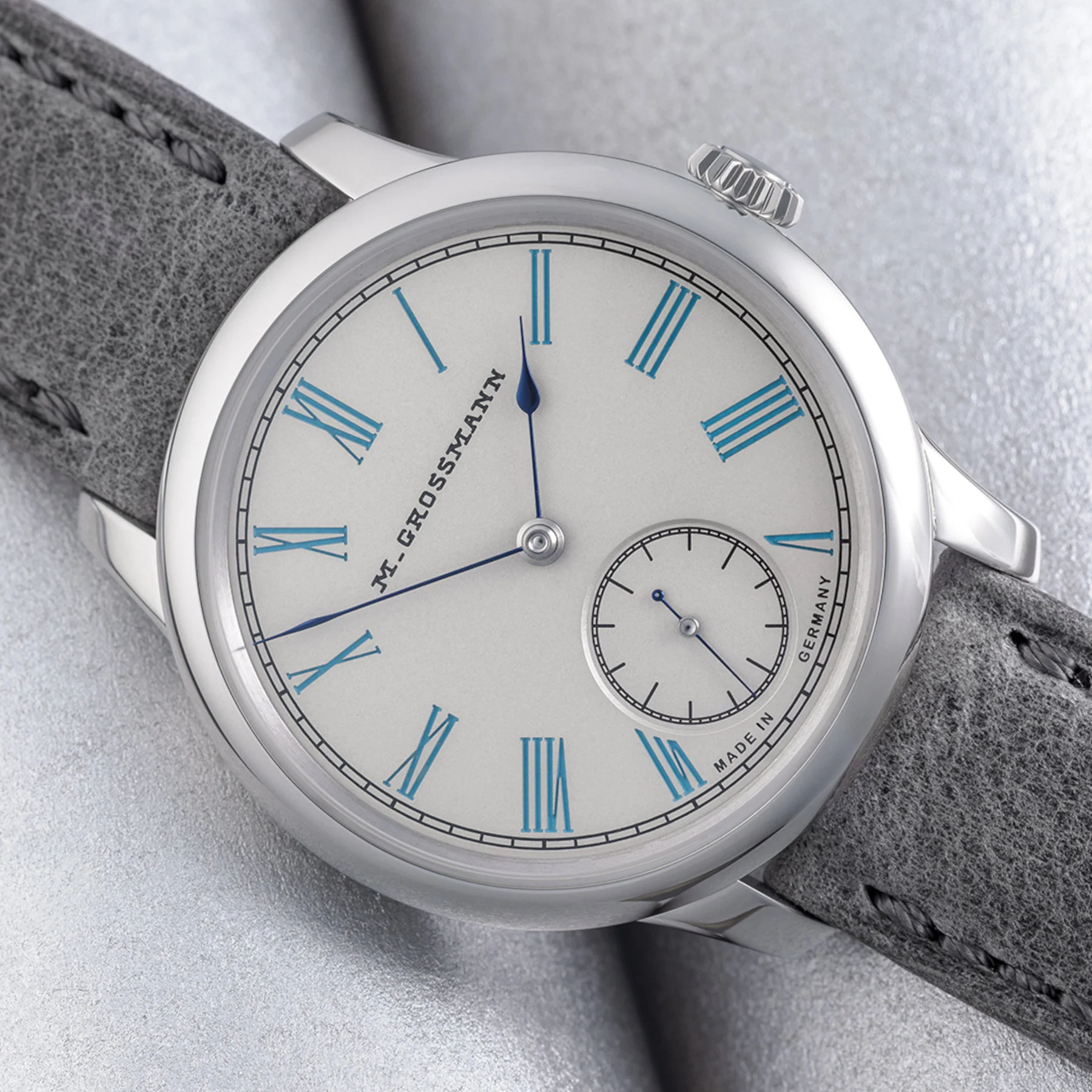
Dial detail: beige silver-plated background, turquoise Roman numerals, blue-annealed hands made in-house. Image: © Moritz Grossmann via Monochrome Watches
The Art of Silver-Plating by Friction: A 19th-Century Technique Revived
The dial of the Moritz Grossmann Tefnut 36 is where the entire watch's raison d'être is located — and it demands the most explanation. Silver-plating by friction is not electroplating. It is not chemical deposition. It is a manual process that was common in the 19th century and is now practiced by only a handful of artisans worldwide. The Monochrome Watches article provides the clearest technical account of the process as Moritz Grossmann performs it:
Before reaching the silver-plating process, the first step involves engraving the Roman numerals into the brass base, which are then filled with turquoise lacquer and fired in a kiln at high temperatures until hardened. The original 1875 "M. Grossmann" logo, the railway minute and small seconds tracks and "Made in Germany" are also treated with lacquer, in this case an inky black colour.
The artisan whips up a mixture of pure silver powder, salt, cream of tartar and water. The paste is applied with a small brush and rubbed in by hand to achieve an ultra-fine, grained texture. After removing the excess paste, the dial is gently polished and then protected with a thin topcoat of lacquer to prevent the silver from tarnishing.
The result is a surface that is matte and velvety rather than shiny — a warmth that electroplating cannot achieve. The turquoise lacquer in the numerals was fired into the brass before the silver was applied, which means the two colours — the beige-silver of the background and the vivid turquoise of the Roman numerals — have separate manufacturing histories embedded in the same dial surface. That is not a decorative choice. It is a craftsmanship choice.
The crowning touch is the application of the wafer-thin hands with razor-sharp tips. Produced in-house by hand, the steel is ground with diamond files and annealed to a bright blue colour over an open flame. The brightly polished chamfers are also achieved by hand using a wooden disc.
The blue-annealed hands against the turquoise Roman numerals create a chromatic dialogue that is subtle enough to read as monochrome at distance and revealing enough to reward close examination.
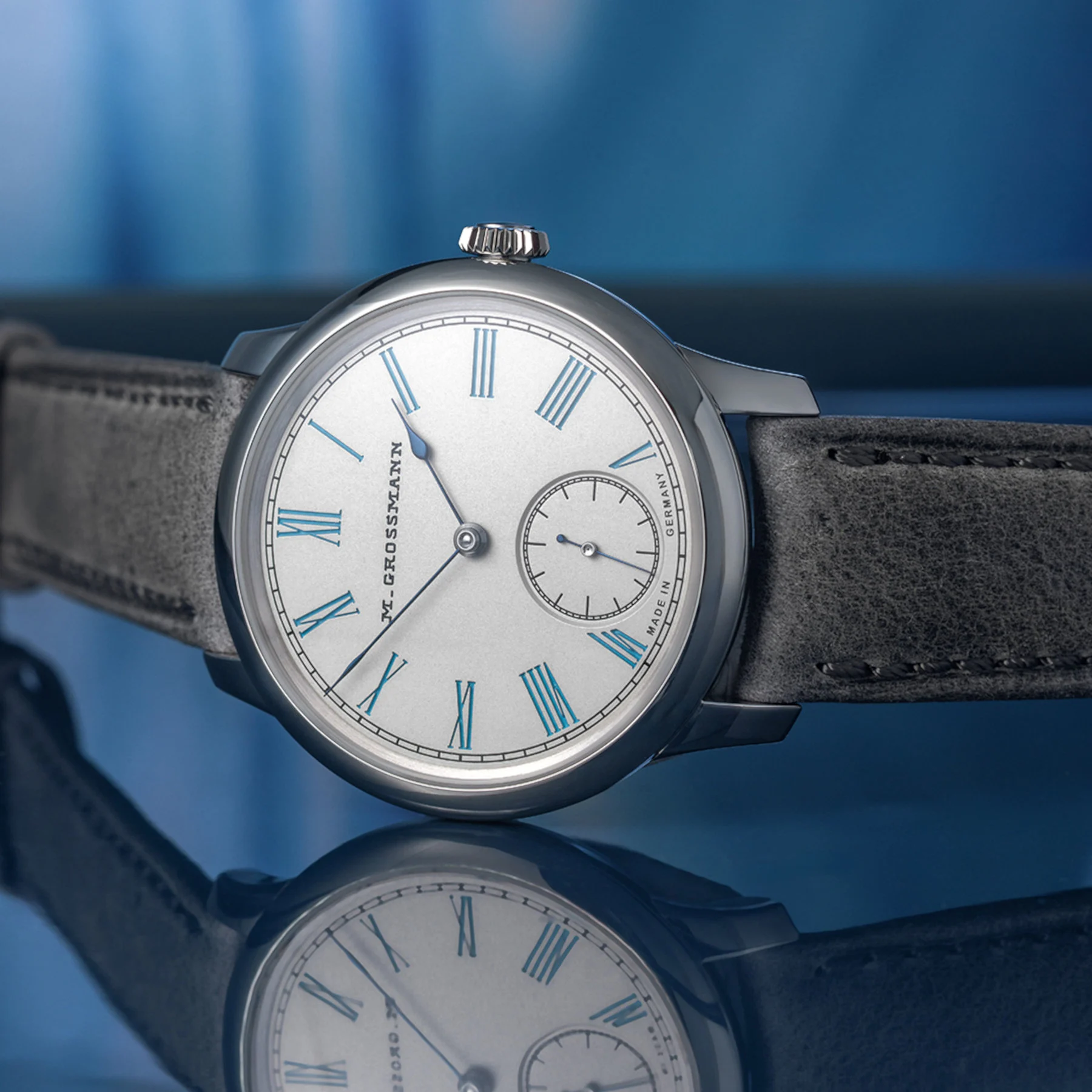
36mm × 8.5mm fully polished case profile — a size that references Grossmann's own 19th-century pocket watch proportions. Image: © Moritz Grossmann via Monochrome Watches
The Movement: Calibre 102.1 in Detail
The mechanical spectacle on the reverse reveals the in-house manual-winding calibre 102.1 with a remarkably slim height of 3.5mm. Decorated to the high standards of Saxon watchmaking, the untreated German silver 3/5 plate features classic wide Glashütte ribbing with polished bevels, and the stepped balance cock is hand-engraved with a floral motif along with a discreet "1826" and a polished Grossmann micrometre screw. Recalling 19th-century pocket watches, clear white sapphires are used instead of synthetic rubies and set into solid gold chatons. The steel screws are individually heat-annealed to a violet-brown hue. On a more technical front, the movement beats at 21,600vph and delivers a 48-hour power reserve when fully wound.
The Grossmann micrometer screw is the founder's own invention — a device for adjusting the rate of the balance without changing the effective length of the hairspring. It is more precise than the conventional regulation pin used by most watchmakers. Its presence on the Moritz Grossmann Tefnut 36 is both a technical advantage and a deliberate historical reference: the "1826" engraved on the balance cock marks the year of Carl Moritz Grossmann's birth, and the screw bearing his name is the direct technical legacy he left to the craft.
The 3/5 plate architecture — with two-thirds of the movement surface covered by a single continuous plate rather than divided into separate bridges — is a Saxon tradition specifically associated with Glashütte. It provides exceptional stability for the gear train and is one of the most visually distinctive elements of any German movement when viewed through the sapphire caseback.
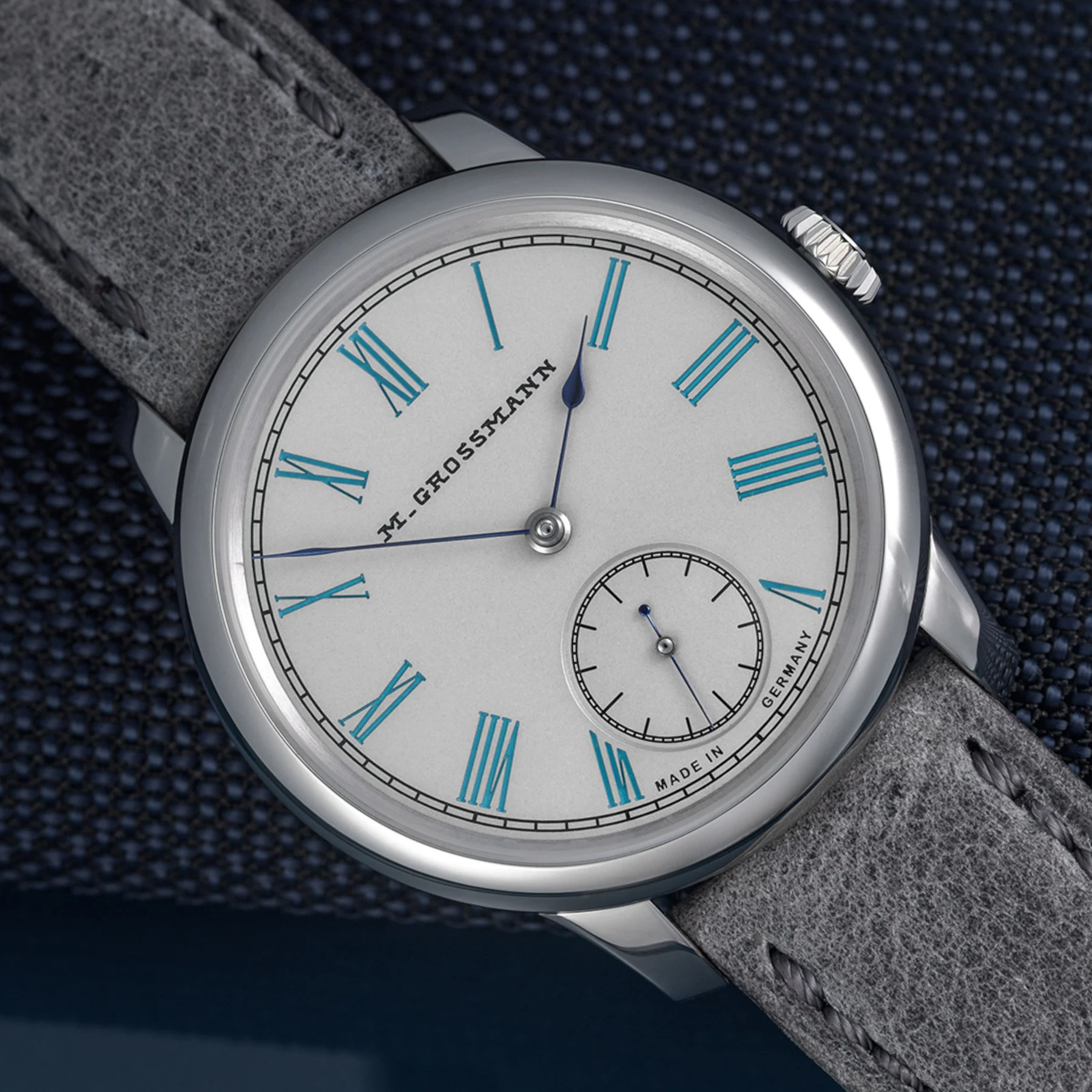
Calibre 102.1 via the sapphire caseback — 3/5 German silver plate, Glashütte ribbing, "1826"-engraved balance cock. Image: © Moritz Grossmann via Monochrome Watches
Moritz Grossmann Tefnut 36 Silver-Plated by Friction Turquoise Blue: Full Specs
Reference: MG-004153
Case: 36mm diameter × 8.5mm height, 3-part stainless steel, fully polished, gently tapered lugs
Crown: Large, flat winding crown
Crystal: Sapphire, front and back
Dial: Beige background, silver-plated by friction on brass base; Roman numerals engraved and filled with turquoise lacquer, kiln-fired; "M. Grossmann" 1875 vintage logo, railway minute track, small seconds tracks in black lacquer; "Made in Germany" in black lacquer; recessed small seconds at 6 o'clock
Hands: Handmade in-house steel, ground with diamond files, annealed blue over open flame; polished chamfers by hand on wooden disc
Movement: Calibre 102.1, manual winding, manufacture
Dimensions: 26mm × 3.45mm
Frequency: 21,600 vph
Power reserve: 48 hours
Components: 188 parts, 22 jewels (3 in solid gold chatons, white sapphires instead of rubies)
Balance: Grossmann balance with micrometer screw, 4 inertia screws, 2 poising screws, Nivarox 1 balance spring, 10mm diameter
Plate: 3/5 German silver plate, wide Glashütte ribbing, polished bevels
Balance cock: Stepped, hand-engraved floral motif + "1826" engraving + Grossmann micrometer screw
Screws: Individually heat-annealed, violet-brown hue
Strap: Bluish-grey kudu leather, steel prong buckle
Limited edition: 12 pieces
Price: EUR 29,000 excl. VAT
More info: grossmann-uhren.com
The 200th Anniversary Series in Context
The Moritz Grossmann Tefnut 36 is the fifth release in what the brand has structured as a series of small-batch anniversary gifts throughout 2026. Each references the founder's era through craft technique:
Hamatic Silver-Plated by Friction — white gold, the first model in the series
Tremblage — gold, hand-engraved
Tefnut Silver-Plated by Friction — white gold (€52,500) and yellow gold (€54,300), green accents, April 2026
Backpage Tremblage — a further edition
Tefnut 36 Silver-Plated by Friction Turquoise Blue — steel, 36mm, turquoise accents, 12 pieces, €29,000
The Moritz Grossmann Tefnut 36 is notable for being the only anniversary model in a steel case — and paradoxically the most accessible in price (though €29,000 is a relative observation). The smaller case size and steel material make it the most wearable of the series without compromising a single element of craft.
Frequently Asked Questions
Q1. What is the Moritz Grossmann Tefnut 36 Silver-Plated by Friction Turquoise Blue?
A 36mm steel limited-edition dress watch (ref. MG-004153) celebrating the 200th anniversary of founder Carl Moritz Grossmann's birth. It features a dial created using the 19th-century technique of silver-plating by friction, with turquoise-lacquered Roman numerals. Limited to 12 pieces at EUR 29,000 excluding VAT.
Q2. What is silver-plating by friction?
A pre-industrial dial-making technique where a paste of silver powder, salt, cream of tartar and water is physically rubbed onto a brass base by hand to create a matte, velvety silver surface. It produces a texture that electroplating cannot replicate, and it was the standard dial-finishing method of the 19th century.
Q3. What is the movement in the Moritz Grossmann Tefnut 36?
Calibre 102.1 — an in-house manual-wind movement measuring 3.45mm in height, beating at 21,600 vph with a 48-hour power reserve. It uses a 3/5 German silver plate with Glashütte ribbing, a hand-engraved balance cock with "1826" inscription, and white sapphires in gold chatons in place of rubies.
Q4. What is the Grossmann micrometer screw?
An invention of Carl Moritz Grossmann himself — a precision regulation device on the balance cock that adjusts the effective hairspring length more precisely than the standard regulation pin. It appears on every Moritz Grossmann movement as a direct technical legacy from the founder.
Q5. Is the Moritz Grossmann Tefnut 36 the only steel model in the anniversary series?
Yes. The other anniversary editions (Hamatic, Tremblage, Tefnut gold editions) are all in precious metal. The Tefnut 36 is the first and only steel case in the 200th anniversary programme.
The Bottom Line
The Moritz Grossmann Tefnut 36 Silver-Plated by Friction Turquoise Blue is a watch that takes more than a glance to reveal itself. The case is simple. The dial looks quiet at distance — almost vintage. But the silver-plating by friction, the kiln-fired turquoise lacquer in the Roman numerals, the flame-annealed blue hands made on a wooden disc, the 1826-engraved balance cock, the white sapphires in gold chatons, the individually heat-annealed violet-brown screws — none of that is visible until the watch is in hand. At 12 pieces, the Moritz Grossmann Tefnut 36 is not a watch for a general release. It is a watch for the 12 people who will know exactly what they have on their wrist. For Monochrome Watches' full introducing article, their original piece remains the most complete source. For more from the world of high-end German watchmaking, see our dress watch guide. The WatchTime article on the broader Moritz Grossmann anniversary programme is also worth reading at WatchTime.