
A surprise Rolex release outside Watches & Wonders is interesting enough on its own. But the new Perpetual Padellone is more than an unexpected addition to the catalogue. It revisits the Ref. 8171, one of Rolex’s more unusual vintage watches, and brings its calendar-and-moonphase formula into the modern Perpetual collection. The result combines familiar historical cues with a considerably more sophisticated movement.
A Vintage Rolex Design, Reworked For Today
The original Ref. 8171 appeared in 1949 and was unusually large for its time at 38mm. Collectors eventually gave it the nickname “Padellone”, Italian for “large frying pan”, thanks to its broad case. It was also an unusual Rolex: a complete calendar with a moonphase, and notably different from the waterproof Oyster watches that had already become central to the brand's identity.
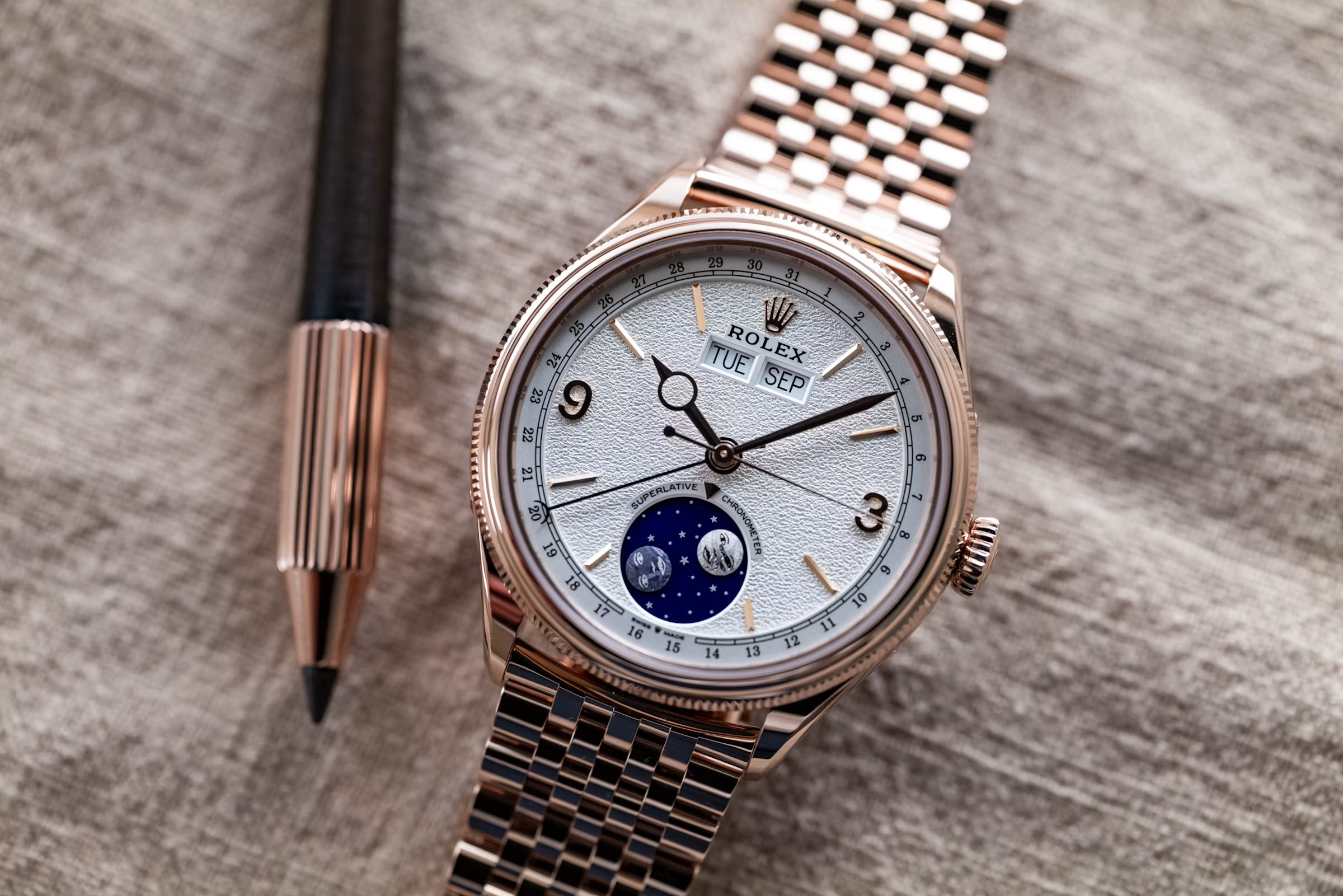
The modern Padellone retains that basic visual idea while giving it a thoroughly contemporary treatment. Its 39mm case is available in 18k Everose gold or 950 platinum, with a fluted bezel and curved case profile inspired partly by the Perpetual 1908. The textured dials feature Arabic numerals at 3 and 9 o’clock, while the moonphase at 6 o’clock uses meteorite discs for the full and new moons.
The Rolex Perpetual Padellone Is More Than A Throwback
The historical connection might be what gets attention, but the real story is underneath the dial.
The Perpetual Padellone introduces an instantaneous annual calendar, displaying the day, date and month. Unlike the original 8171, which required more frequent manual correction, the new mechanism only needs adjustment once a year, when February gives way to March. The three calendar indications also change simultaneously at midnight.
The moonphase adds another layer to the vintage-inspired design. It completes one rotation in approximately 29.53 days, while the display itself uses a fully visible enamel disc rather than the half-aperture seen on the original watch. It means the Padellone isn't simply borrowing an old Rolex aesthetic; it is using that history as the starting point for a modern complication.
Inside Rolex’s New Calibre 7190
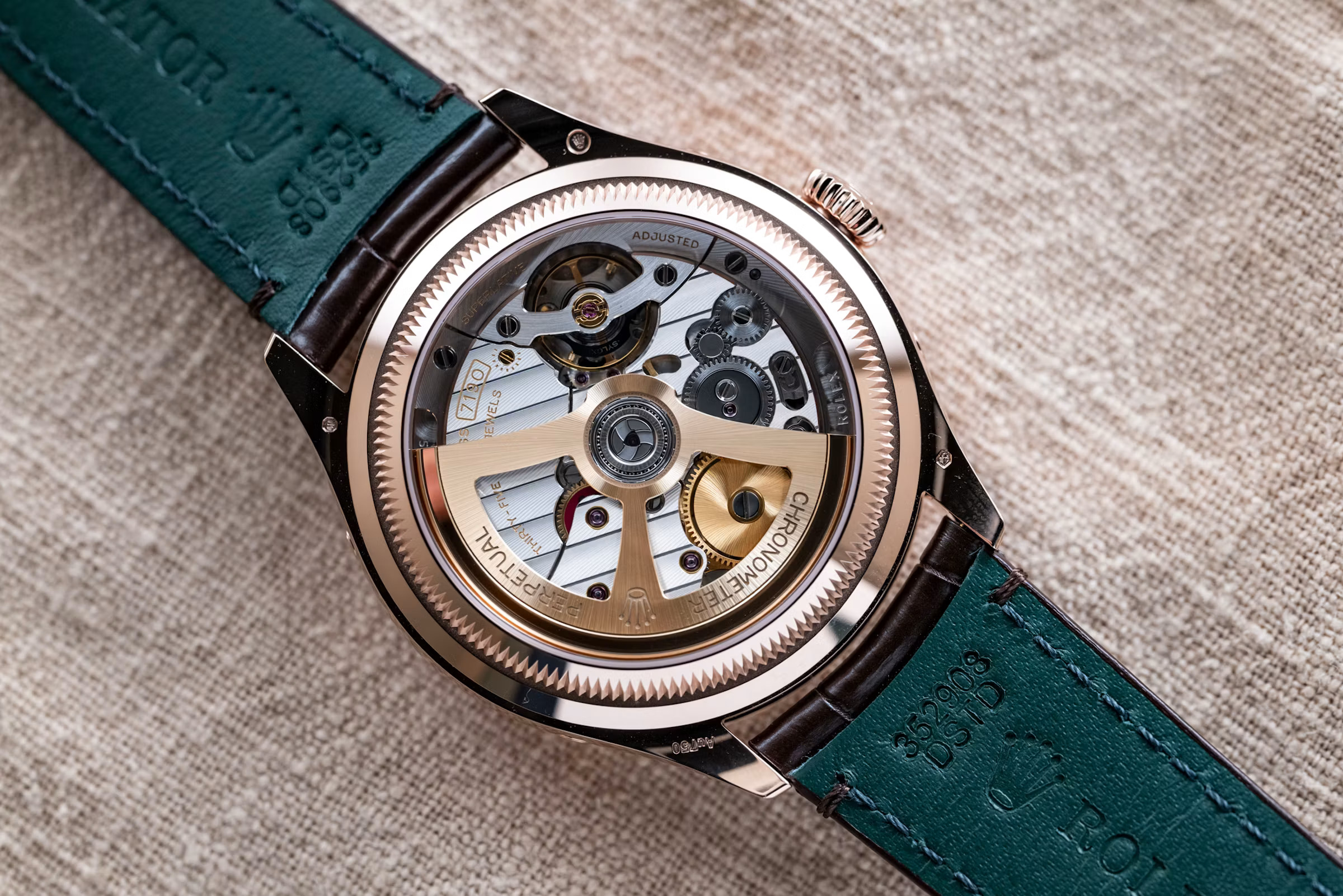
Powering the watch is the new Calibre 7190, an evolution of the Calibre 7135 architecture and the latest Rolex movement to build around the brand's Dynapulse escapement. The system was first introduced with the Land-Dweller and uses a direct-impulse approach designed to reduce friction and improve the efficiency of power delivery.
That makes the movement particularly interesting in the context of the Padellone. Rolex isn't simply placing an old complication inside a new case. The annual calendar has been engineered around a modern movement architecture, including Rolex's patented approach to the instantaneous calendar change. The result is a watch that sits at the intersection of vintage design and some of the brand's newest mechanical developments.
Three Versions, Three Takes On The Padellone
The new Rolex Perpetual Padellone comes in three configurations.
The first pairs an Everose gold case with a white, heavily grained dial and an alligator strap, priced at $59,000. The second uses a 950 platinum case and ice-blue dial, again with an alligator strap, at $66,200. The third combines Everose gold and the white dial with Rolex's Settimo bracelet, taking the price to $72,800.
The three versions give the same watch noticeably different personalities, but the platinum model arguably makes the strongest visual departure, particularly with its ice-blue dial and dark-blue moonphase.
The new Rolex Perpetual Padellone is an interesting move precisely because it doesn't feel like another variation on one of the brand's familiar sports watches. Instead, it reaches back to a relatively obscure chapter in Rolex history and gives it a thoroughly modern mechanical foundation. The 8171 may have been the original Padellone, but this new version is very much a watch for Rolex's present.