
The Longines Master Collection Chrono Monopusher is the headline complication from the second phase of Longines' 2026 Master Collection redesign — and a genuine first for the range. No Master Collection watch has carried a monopusher mechanism before. The single pusher integrated into the 41mm crown controls all three chronograph functions: one press to start, one to stop, one to reset. A pulsometer scale around the dial's edge turns it into what watchmakers historically called a doctor's watch, allowing medical professionals to read pulse rate directly from the scale after timing 30 heartbeats. Available in frosted blue (ref. L2.960.4.93.2) and silver opaline (ref. L2.960.4.78.2), both at $3,900 / €3,800 / ₹3,88,000, this is the most distinctive watch Longines has added to the Master lineup in years.
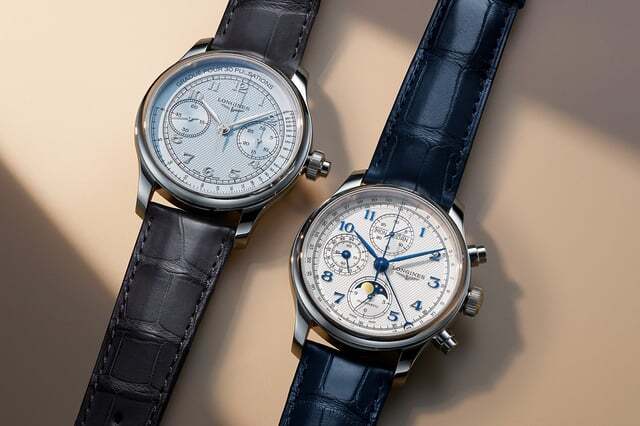
The two new Master Collection complications — Chrono Monopusher (left) and Chrono Moonphase (right). © Longines
The Monopusher: Why It Matters
A monopusher chronograph uses one control point for the entire chronograph sequence rather than the conventional two separate pushers at 2 and 4 o'clock. The aesthetic result is a cleaner case profile — no pusher visible from the side, no break in the lugs. The mechanical result is a more linear sequence: start, stop, reset in order, no skipping. Longines' history with the type runs deeper than most. The brand introduced one of the earliest wrist monopushers in 1911, before most chronographs had migrated from the pocket to the wrist. The calibre 13.33Z followed in 1913 — one of the first compact wrist chronograph movements ever produced at scale. The 2026 Chrono Monopusher places that heritage back at the front of Longines' most visible collection.
The Longines Master Collection Chrono Monopusher in Frosted Blue — Ref. L2.960.4.93.2
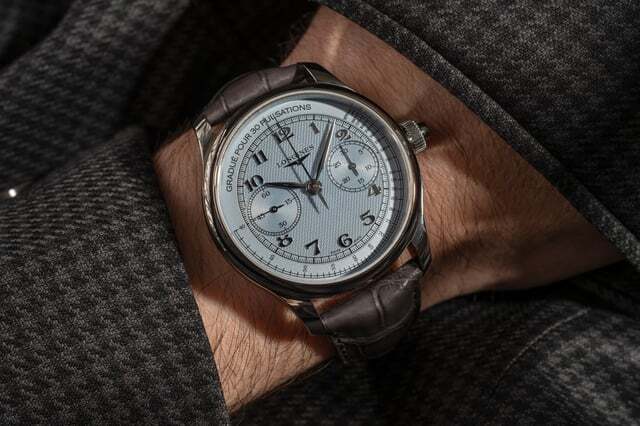
Frosted blue barleycorn dial, snailed sub-dials at 3 and 9, printed pulsometer scale. © Zen Love / WatchTime
The frosted blue reference wears the new Master Collection barleycorn guilloché pattern introduced across the 2026 family in June. The pattern is fine, receding under the two snailed sub-counters at 3 o'clock (30-minute register) and 9 o'clock (small seconds), and dissolving into a sandblasted outer ring. Applied rhodium-plated Arabic numerals and polished leaf-shaped hands sit over the guilloché without overwhelming it. The pulsometer scale runs as a black printed outer track between the numerals and the edge — legible, calibrated, and visually cohesive with the rest of the layout. Strap: anthracite alligator leather with micro-adjustable triple folding clasp.
The Silver Opaline — Ref. L2.960.4.78.2
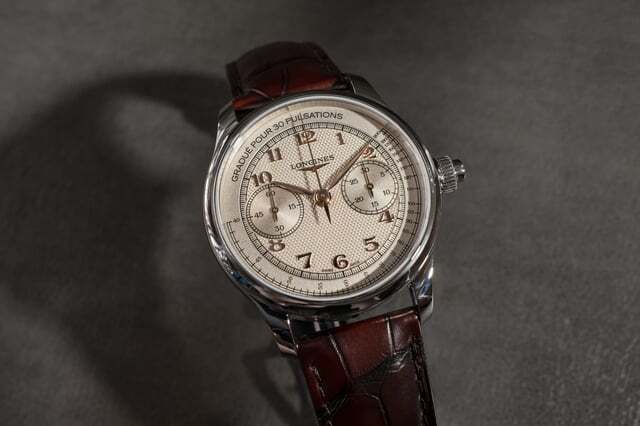
Silver opaline reference — 5N rose gold-plated numerals and hands on the same barleycorn pattern. © Zen Love / WatchTime
The silver opaline reference takes the same barleycorn architecture and shifts the finishing warmer: applied Arabic numerals and leaf hands in 5N rose gold plating rather than rhodium. The warmth reads as distinctly vintage — the snailed counter subdials remain silver-toned, providing soft contrast to the gilded elements. Strap: brown alligator leather, same micro-adjustable folding clasp as the frosted blue. The two references are mechanically identical; the choice comes down entirely to dial palette and strap tone.
Calibre L799.5: Hand-Wound, Column-Wheel, 68 Hours
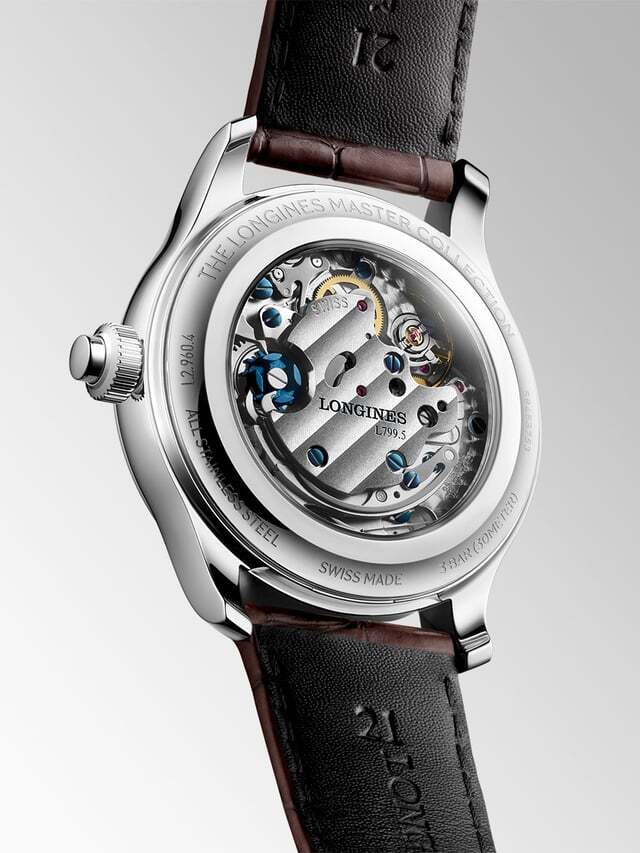
Calibre L799.5 through the sapphire caseback — blued column wheel, Geneva stripes, perlage. © Longines
The Calibre L799.5 is a Longines-exclusive manually wound column-wheel chronograph, based on the L788 series used in previous Longines monopushers. Vertical clutch, silicon balance spring, 28,800vph (4Hz), and a 68-hour power reserve from a single barrel. Decoration: blued screws, blued column wheel, Geneva stripes on the top bridge, polished levers and wheels, perlage on the mainplate. The brand name and calibre designation are engraved and filled with blue lacquer. All of this is visible through the sapphire caseback. Manual winding rather than automatic is the correct architectural call here — it keeps the 12.6mm case height achievable and gives the watch its mechanically vintage character.
The 41mm × 12.6mm polished stainless-steel case has a knurled crown with the pusher integrated at 3 o'clock and sapphire front and back. Water resistance is 30m. The micro-adjustable triple folding clasp with push-piece opening is shared across both strap options.
Also New: Master Chrono Moonphase at $4,250 / ~₹4,50,000
Alongside the Monopusher, Longines also unveiled the Master Collection Chrono Moonphase (ref. L2.962.4.73.6) — also 41mm, also with the barleycorn guilloché dial, but fitted with the self-winding Calibre L687.5 (column-wheel, silicon balance spring, 66-hour power reserve), a full calendar, and a moonphase integrated into the 12-hour chronograph counter at 6 o'clock. Available on blue leather or steel bracelet at $4,250 (~₹4,50,000 approx.). For more chronograph launches, see our chronograph watch archive. Both new complications are now available on the Longines India website and at Longines boutiques worldwide.