
There is a version of this story that is just a number. The Konstantin Chaykin ThinKing Mystery is 1.65mm thick, which makes it the thinnest mechanical wristwatch ever built, and you could stop reading there.
The more interesting version is what the number has been through. When Chaykin first showed the ThinKing at Geneva Watch Days in 2024, it beat Bulgari's Octo Finissimo Ultra by five hundredths of a millimetre and the watch world had a small argument about whether it counted. It was a prototype. You could not buy one. Bulgari, whose Octo Finissimo Ultra COSC costs upward of half a million dollars, could reasonably keep saying it made the thinnest watch anyone could actually own.
ThinKing Mystery closes that argument. Twelve pieces, series production, same 1.65mm. Chaykin's own framing is unusually honest about it: the first watch redefined the limit, and this one turns that record into a stable, repeatable architecture. Anyone can build one impossible thing once. Building twelve is a different discipline entirely.
How the Konstantin Chaykin ThinKing Mystery gets to 1.65mm
At this scale the usual distinction between case and movement stops existing. The Konstantin Chaykin ThinKing Mystery hides its cleverest work here. The in-house calibre K.23-3.1 is integrated directly into the case, and the caseback does double duty as the mainplate. The gear train is spread across two levels rather than stacked, which is what keeps the vertical profile down. The whole thing is 41mm across, 284 components, and weighs 12.1 grams without a strap. That is roughly the weight of three sheets of A4 paper.
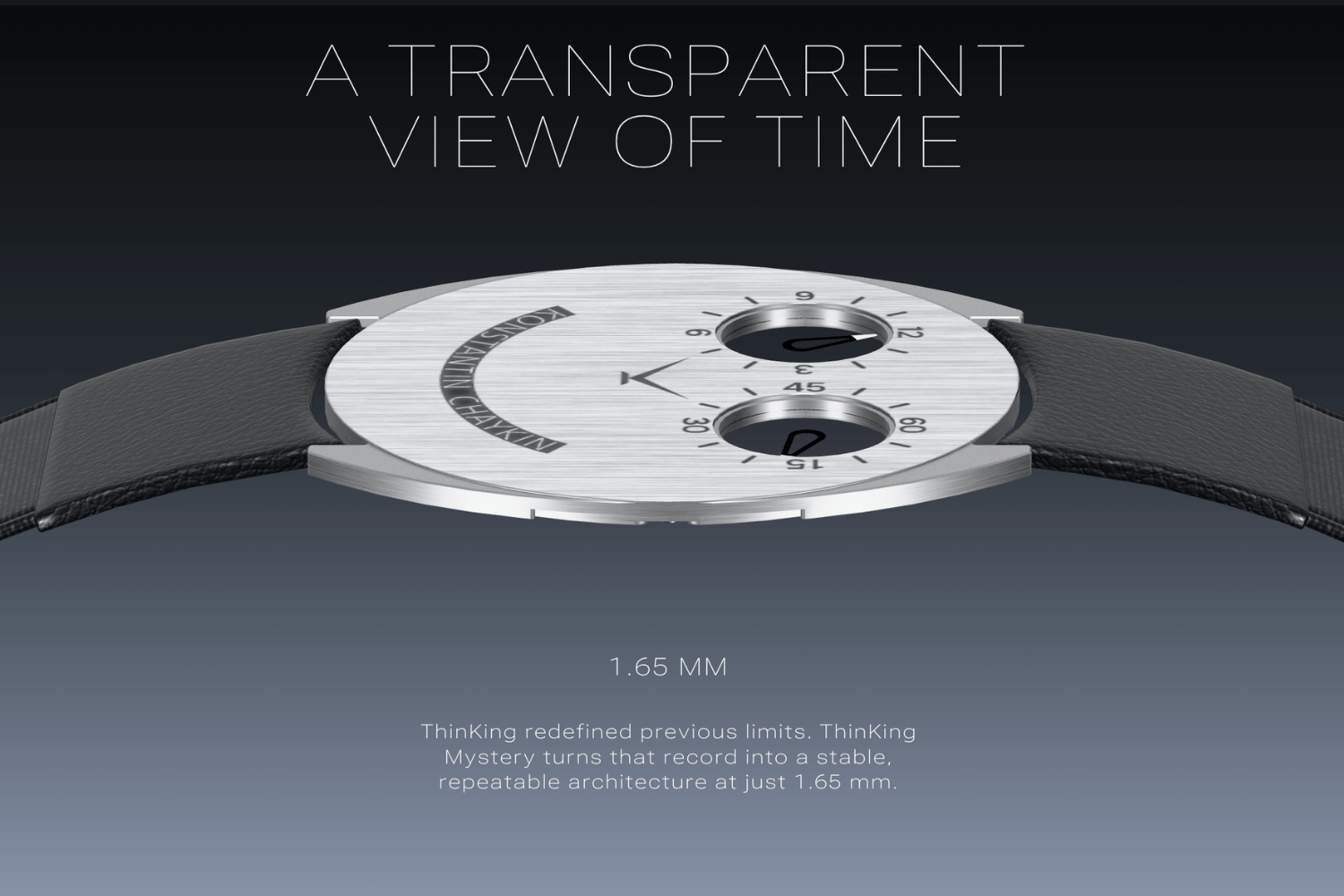
One point six five millimetres, edge on. There is no room in there for anything conventional.
The material choice tells you something too. Gold would not survive at these tolerances, so Chaykin uses a high-strength precision alloy with the rigidity and corrosion resistance to hold shape when you are working to thousandths of a millimetre. At 1.65mm, a case that flexes even slightly is a case that stops the movement.
Three of the solutions here are patented, which is a dense concentration of invention for one watch.
The balance is the cleverest. Instead of stacking components vertically the way a normal balance does, Chaykin splits it into two balances arranged across two levels within a single plane, coupled by gearing on their rims. The primary balance handles frequency and isochronism, the job a balance is supposed to do. The intermediate one carries the impulse jewel and talks to the escapement fork. It runs at a deliberately slow 18,000 vibrations per hour.
The barrel has no cover. The upper bridge performs that function instead, reinforced with structural supports, and the arbor works as an overrunning clutch running on tungsten carbide balls. It delivers 38 hours of power reserve from a single ultra-thin barrel.
Even the strap is engineered. It uses titanium stiffeners with elastic inserts, because a conventional strap would twist a case this thin.
The watch with no crown
Here is where the Konstantin Chaykin ThinKing Mystery gets divisive, and I think interestingly so.
There is no crown. There is nowhere to put one. So winding and setting happen externally, using either a carbon and stainless steel winding box measuring 47 by 43 by 9.2mm, or a slim 94mm steel key that slots into the caseback. The box is a small machine in its own right, 112 components including a safety reversing clutch. The key has 26. Both have safety mechanisms built in specifically to stop an owner over-tensioning a mainspring that has almost no margin for error.
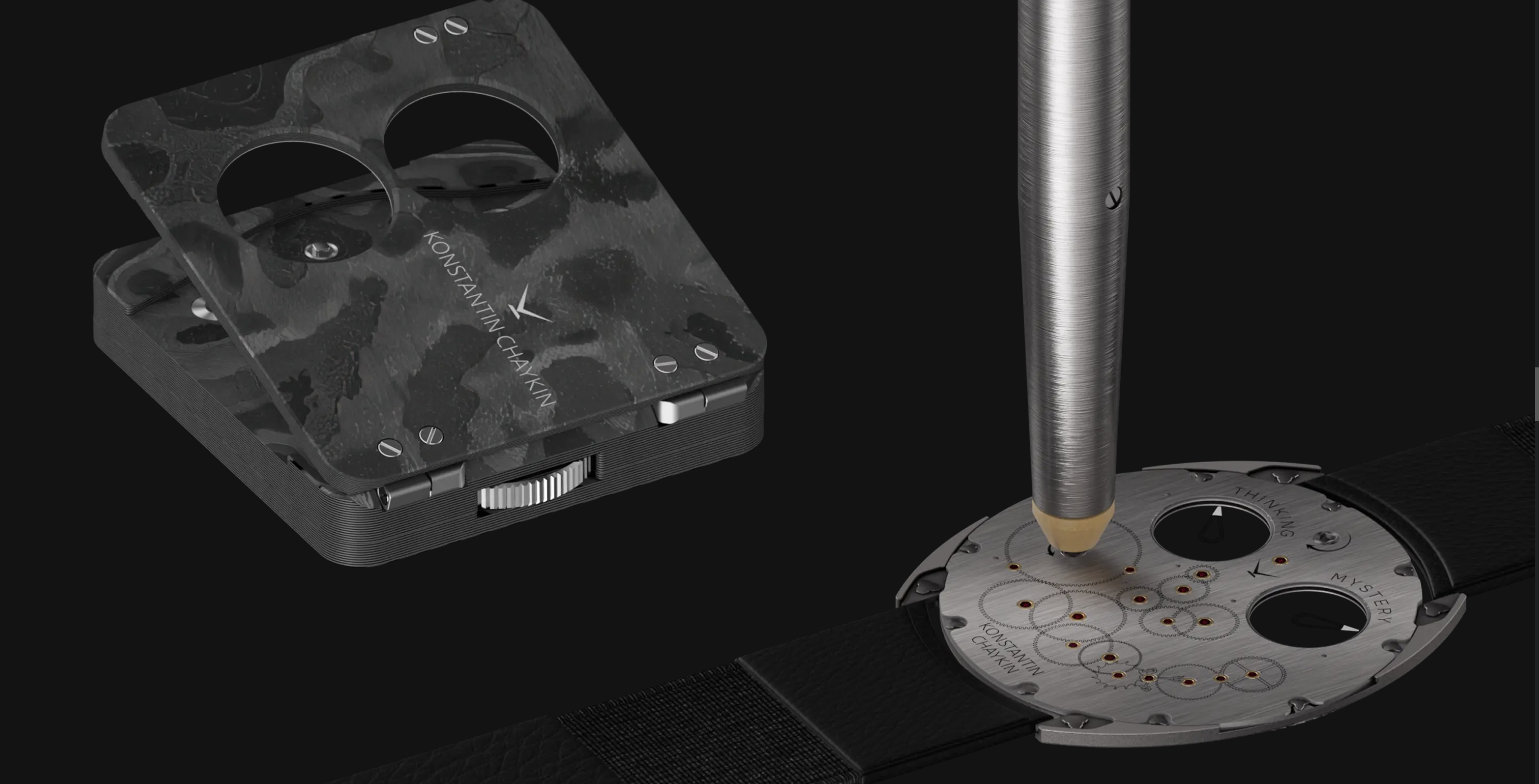
With nowhere to put a crown, winding and setting move outside the watch entirely.
Purists will say this is cheating, that if it takes an accessory to operate the watch then the accessory should count in the measurement. It is a fair argument. It is also one Bulgari has already faced, since its own Octo Finissimo Ultra COSC ships with a separate setting box for the same reason. Once you go below about two millimetres, the crown is simply not a shape that fits any more. You either give it up or you stop going thinner.
What Mystery actually refers to
The name is not about secrecy. It is a specific horological term for a display where the hands appear to float with no visible connection to the movement, and Chaykin has built it at a scale that sounds made up.
Hours and minutes are printed on two solid sapphire discs, each 10.6mm across and 0.2mm thick. They sit behind four sapphire crystals of 0.3mm. There is no central axle, because there is no room for one. The discs are driven laterally from their edges, which eliminates axial wobble by design rather than by correction. Three rollers sit around each disc to guide it, cutting radial runout to nearly nothing and reducing the energy the barrel loses to friction.
That last part matters more than the visual effect. In a watch running on a single ultra-thin barrel with 38 hours to spend, every source of drag is a threat to whether it runs at all. The floating display is beautiful, but it earns its place because it is efficient.
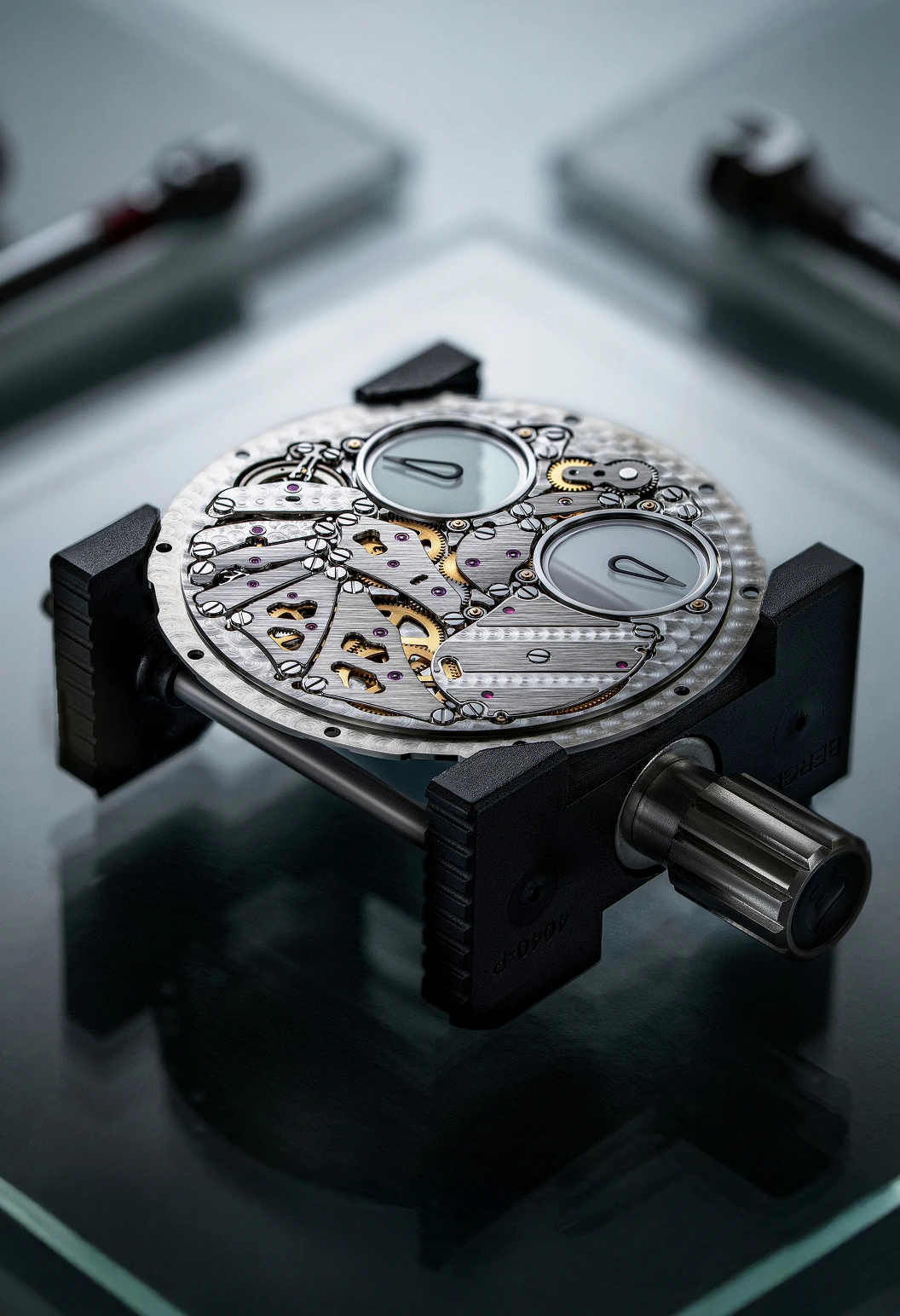
The calibre K.23-3.1, built into the case itself rather than dropped inside it.
Twelve pieces, and no published price
The edition is twelve. Chaykin has not published a price, and allocation runs through what the manufacture calls a closed review process, with priority to existing collectors, long-term partners, and buyers who can make a substantiated case for wanting one.
For scale, Bulgari's ultra-thin flagship sits in the region of half a million dollars. It is safe to assume this is not less.
Why Indian collectors should care about a watch none of them will own
Twelve pieces means this is a watch almost nobody reading this will ever handle, so the honest question is why it matters here at all.
The Indian market has skewed hard toward sports watches and recognisable steel, which is a rational place for a maturing market to start. Ultra-thin is the opposite proposition. There is no bezel, no bracelet, no water resistance, nothing that photographs as tough. What it offers is engineering you have to understand to appreciate, which is exactly the direction serious collecting eventually goes.
There is also the independent question. India has warmed to the big Swiss names far faster than to independent watchmaking, and IAMWATCH in Singapore this November is one of the few realistic chances to see that world up close. A one-man Moscow manufacture beating Bulgari, Piaget and Richard Mille at their own decades-long game, in a year when even Panerai's headline release was about shaving weight rather than millimetres, without a specialist movement supplier behind it, is the clearest argument going for why independents deserve the attention.
The ThinKing Mystery is not a watch you buy. The Konstantin Chaykin ThinKing Mystery is a watch that tells you what is possible, which is a different kind of useful.
Sources: Konstantin Chaykin, SJX Watches, Monochrome Watches, Wallpaper.