
The H. Moser Endeavour Cosmic Rain is, by any reasonable account, the most technically ambitious watch the Schaffhausen manufacture has released to date. With the Endeavour Minute Repeater Cylindrical Tourbillon Skeleton Cosmic Rain, H. Moser & Cie. unites three of haute horlogerie's most demanding complications and disciplines in a single timepiece: a minute repeater, a fully skeletonized manufacture movement, and a rare flying tourbillon with a cylindrical hairspring — completed by an intricately crafted aventurine sub-dial with mother-of-pearl marquetry that evokes the appearance of shimmering stars across the night sky. Limited to 20 pieces worldwide with pricing at CHF 378,350 including taxes, the H. Moser Endeavour Cosmic Rain (ref. 1909-0501) — see the official H. Moser page is also H. Moser's entry into the Mechanical Exception category of the GPHG 2026.
For more from H. Moser & Cie.'s complication range, see our H. Moser archive and our tourbillon watches guide. Here is everything worth knowing.
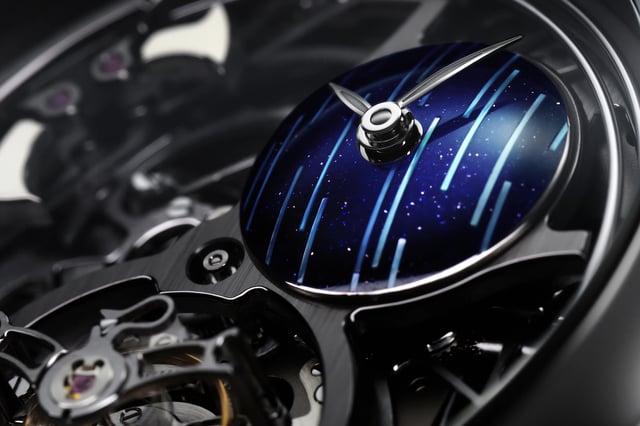
H. Moser Endeavour Cosmic Rain, ref. 1909-0501 — 20 pieces at CHF 378,350. Image: © H. Moser & Cie. via WatchTime
What Is the H. Moser Endeavour Cosmic Rain?
The H. Moser Endeavour Cosmic Rain is a limited-edition version of the Endeavour Minute Repeater Cylindrical Tourbillon Skeleton — itself a watch that H. Moser launched at Watches and Wonders 2026 as a new skeletonized presentation of their minute repeater and cylindrical tourbillon combination. The Cosmic Rain edition takes that already complex platform and replaces the standard fumé sub-dial with a miniature work of art.
H. Moser & Cie. released its first minute repeater coupled with a tourbillon in 2019, exposing both complications on the dial. After several iterations, Moser unveiled an impressive, skeletonised take on the double-complication combination at Watches and Wonders 2026. Since skeletonisation is often considered a complication in its own right, the triple-complication Endeavour Minute Repeater Cylindrical Tourbillon returns as the Cosmic Rain — a 20-piece titanium edition that pairs extreme mechanical sophistication with an artistic aventurine-and-mother-of-pearl dial designed to recreate a meteor shower.
The new dial is the only change. Everything else — the titanium case, the HMC 909 calibre, the strap — is identical to the standard skeleton edition. That is not a criticism. It is the point: H. Moser has taken one of watchmaking's most complex mechanical architectures and shown it can accommodate a completely different artistic identity without compromising the mechanics.
The Minute Repeater on the Dial Side: Why It Matters
The minute repeater is arranged on the dial side, placing the mirror-polished hammers and curved gongs between approximately 9 and 11 o'clock. Achieving this display required far more than opening up an existing movement. The calibre had to be designed around the repeater, the tourbillon and the need for structural rigidity, with the gongs arranged on the same plane to avoid interfering with the regulating organ below.
The conventional approach — used by virtually every other watchmaker who builds a repeater tourbillon — is to keep the chiming mechanism on the reverse of the movement. This protects the acoustic components from dust and contact but hides them completely. H. Moser reversed that decision for the H. Moser Endeavour Cosmic Rain: the hammers and gongs are on the front, between 9 and 11 o'clock, and you can watch them move as the watch chimes.
The minute repeater chimes the time acoustically at the press of a button, triggering tiny gong strikes inside the case — a low-pitched chime for each hour, a two-tone chime for each quarter-hour, and a high-pitched chime for every minute past the last quarter. The titanium case itself assists the chiming: H. Moser hollowed the case specifically to act as a resonance chamber, amplifying and sustaining each vibration. The slide on the left side of the case activates the striking mechanism, fitted with a Teflon runner for smooth, frictionless operation.
The calibre had to be rebuilt from scratch to accommodate both the dial-side repeater and the 6 o'clock tourbillon in a single skeletonized plane. Every bridge was designed specifically for this configuration. This unconventional construction required a complete redesign of the hand-wound Caliber HMC 909. Comprising 415 individual components, the movement beats at 21,600 vibrations per hour and offers a power reserve of 90 hours.
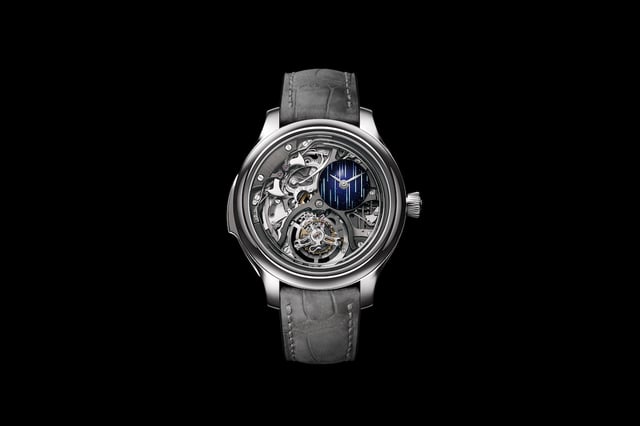
The dial side: minute repeater visible at 9–11 o'clock, tourbillon at 6, sub-dial at 2. Image: © H. Moser & Cie. via WatchTime
The Cylindrical Tourbillon: Rare and Hand-Formed
At 6 o'clock, the flying tourbillon carries one of watchmaking's most technically demanding regulating organs: a cylindrical hairspring. Originally developed for precision marine chronometers in the 18th century, the hairspring coils vertically around the balance staff rather than expanding in a flat plane, improving concentric breathing and supporting more consistent timekeeping. Each cylindrical hairspring is handcrafted by Precision Engineering AG, H. Moser & Cie.'s sister company, using highly specialized manufacturing techniques that only a handful of companies still master today.
The difference between a cylindrical and a flat hairspring is not simply a matter of geometry. A flat spiral hairspring expands and contracts in a plane — if not perfectly calibrated, it can breathe asymmetrically, which introduces small positional errors. A cylindrical hairspring breathes concentrically: each coil rises vertically, and the expansion and contraction of the column are more uniform. The historical association is with 18th-century marine chronometers, where absolute precision at sea justified the extraordinary manufacturing challenge. H. Moser is one of the very few modern watchmakers who produces this component in-house.
The Cosmic Rain Sub-Dial: Aventurine, Mother-of-Pearl, Marquetry
Providing a striking contrast to the open mechanics is the small domed hours-and-minutes sub-dial positioned at 2 o'clock. Crafted from aventurine glass, it features H. Moser & Cie.'s signature fumé effect. Fragments of differently coloured aventurine are applied by hand and fired several times before fine strips of mother-of-pearl are inlaid into the engraved surface. The result resembles a shower of stars crossing the night sky, giving the watch its "Cosmic Rain" designation.
The disk of aventurine glass with a mother-of-pearl inlay encourages the imagination to visualize different scenarios — glowing lights descending from a starlit sky, or a meteor shower falling past the porthole of a spacecraft voyaging through the cosmos. The aventurine provides the base: a deep, dark material scattered with golden flecks that catch light, mimicking a star field. The mother-of-pearl strips, applied as vertical inlays over the aventurine surface, represent the falling stars themselves — bright, linear, intersecting the night sky at an angle.
The technique involved — applying aventurine fragments by hand, firing, engraving the surface, and inlaying MoP strips — is classified under Métiers d'Art. It is a category of watchmaking technique that combines the precision requirements of haute horlogerie with the craft traditions of fine art. This is a step beyond what H. Moser typically does with dials — pairing multiple materials, multiple textures and multiple patterns into a single display in order to create a specific visual image. It's like walking through a Piet Mondrian gallery and suddenly finding a Van Gogh.

Calibre HMC 909 through the sapphire caseback — 415 components, 90-hour power reserve, double-stripe finishing. Image: © H. Moser & Cie. via WatchTime
The Calibre HMC 909: Built Around Its Own Complications
Creating this visual appeal also creates a few headaches for the watchmakers. There are no traditional plates in place to hold things together, and because nearly all of the 415 components and 35 jewels are on display at all times, there is very little room for error when it comes to decoration.
The HMC 909 is a hand-wound movement — an appropriate choice for a minute repeater complication where every gram of energy budget matters, and where the automatic winding rotor would only complicate the acoustic geometry further. The movement's 3D skeleton architecture means the bridges themselves are the design: finished with H. Moser's signature double stripes and chamfered edges by hand, they create a three-dimensional mechanical landscape visible simultaneously from front and back through sapphire crystal on both sides.
The movement also carries Moser's characteristic double-stripe decoration: two parallel polished grooves running along each bridge surface, a finishing technique that requires hand application and is one of the harder finishing processes to execute consistently.
H. Moser Endeavour Cosmic Rain: Full Specs
Reference: 1909-0501
Case: 40mm diameter × 14.4mm height, titanium (hollowed for acoustic resonance)
Crystal: Sapphire, front and back
Water resistance: 30m
Minute repeater: Dial-side; hammers and gongs visible at 9–11 o'clock; chimes hours, quarters, minutes; slide activation with Teflon runner; hollow titanium case as resonance chamber
Tourbillon: Flying one-minute tourbillon at 6 o'clock with cylindrical hairspring (hand-formed by Precision Engineering AG)
Sub-dial: Off-centre at 2 o'clock; hours and minutes; domed aventurine glass with hand-applied aventurine fragments, fired, engraved, mother-of-pearl strip inlays
Movement: HMC 909, hand-wound, fully skeletonised, 3D architecture
Frequency: 21,600 vph (3 Hz)
Components: 415
Jewels: 35
Power reserve: 90 hours
Finishing: Double-stripe polishing (Moser signature), hand-chamfered bevels
Strap: Grey nubuck alligator leather, hand-stitched, titanium pin buckle
GPHG 2026: Entered in Mechanical Exception category
Limited edition: 20 pieces
Price: CHF 378,350 including taxes (~$440,000)
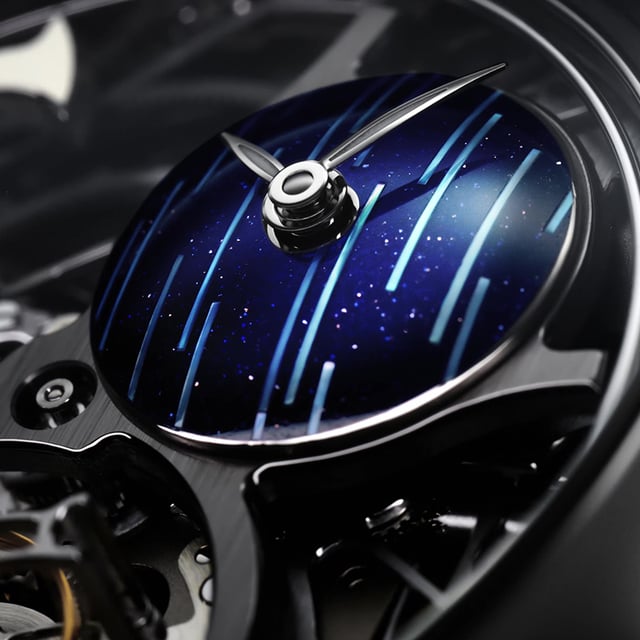
The Cosmic Rain sub-dial close-up: aventurine fragments, MoP strip inlays, fumé effect — the watch's defining artistic element. Image: © H. Moser & Cie. via WatchTime
What Makes This Different from the Standard Skeleton
The standard Endeavour Minute Repeater Cylindrical Tourbillon Skeleton (ref. 1909-0500) features H. Moser's "Funky Blue Fumé" enamel sub-dial — the brand's signature midnight-to-cerulean gradient. The H. Moser Endeavour Cosmic Rain replaces that sub-dial with the aventurine-and-MoP marquetry. The case, movement, strap, and all technical specifications are identical between the two references.
The practical implication: collectors are choosing an aesthetic character rather than a mechanical upgrade. The Cosmic Rain is for those who want the mechanical theatre of the repeater-tourbillon combination wrapped in something that reads as art as much as horology. The blue fumé version is the more classical expression; the Cosmic Rain is the more painterly one.
Frequently Asked Questions
Q1. What is the H. Moser Endeavour Cosmic Rain?
The full name is the Endeavour Minute Repeater Cylindrical Tourbillon Skeleton Cosmic Rain (ref. 1909-0501). It is a 20-piece limited edition combining a dial-side minute repeater, a flying tourbillon with a cylindrical hairspring, and a fully skeletonized movement in a 40mm titanium case. The Cosmic Rain adds an aventurine-and-mother-of-pearl marquetry sub-dial to the base Skeleton model.
Q2. How much does the H. Moser Endeavour Cosmic Rain cost?
CHF 378,350 including taxes, approximately $440,000 USD.
Q3. What is the cylindrical hairspring in the H. Moser Endeavour Cosmic Rain?
A regulating component where the balance spring coils vertically rather than lying flat, providing more concentric breathing and more consistent timekeeping. Originally developed for 18th-century marine chronometers. Each one is hand-formed by Precision Engineering AG, H. Moser's sister company.
Q4. How does the minute repeater work on the H. Moser Endeavour Cosmic Rain?
A slide on the left side of the case activates the striking mechanism. The watch then chimes the current time using three types of strike: low-pitch for each hour, two-tone for each quarter-hour, and high-pitch for each minute past the last quarter. The mechanism is visible on the dial side rather than hidden behind the movement.
Q5. Why titanium for a minute repeater case?
Titanium was selected specifically for its acoustic properties — it amplifies and sustains the vibrations from the chiming mechanism more effectively than steel or gold. The H. Moser Endeavour Cosmic Rain case is also hollowed to function as a dedicated resonance chamber.
Q6. Is the H. Moser Endeavour Cosmic Rain at the GPHG 2026?
Yes. H. Moser entered the Endeavour Minute Repeater Cylindrical Tourbillon Skeleton Cosmic Rain into the Mechanical Exception category at the Grand Prix d'Horlogerie de Genève 2026.
The Bottom Line
The H. Moser Endeavour Cosmic Rain is not the most complicated watch at CHF 378,350. Patek Philippe and A. Lange & Söhne make repeaters with more functions; Richard Mille makes tourbillons with more material innovation. What the H. Moser Endeavour Cosmic Rain offers is something specific: a watch where the entire movement is architecture, the chiming mechanism is theatre, and the sub-dial is a painting. Three disciplines — acoustics, horology, and Métiers d'Art — in a 40mm titanium case, available to 20 people worldwide. For the full WatchTime article with additional images, their introducing piece is the most recently updated source. For Fratello's hands-on take, their Cosmic Rain review adds useful wrist context. For more from H. Moser's Endeavour range, see our skeleton watches guide.