
The Christopher Ward Twelve Xander is the most ambitious piece the British brand has ever produced — a 150-piece limited edition that pairs the skeletonised Twelve X titanium case with something that has never been done in production watchmaking before: a movement that has been entirely hand-painted by an external artist before assembly. Working from his studio in Perth, Scotland, British street artist Chris Alexander — better known as The Dial Artist — spent 50 days and 900 hours applying graffiti-inspired, multilayered paint across eight visible movement components on each of the 150 watches, touching over 1,300 individual parts in the process. The result is a watch where no two examples are identical, every surface tells a different story, and the movement itself is the artwork. Price: $5,995 / £4,325 on the white rubber strap; $6,515 / £4,710 on the titanium bracelet. Available from July 10, 2026.
For more from Christopher Ward's collection, see our Christopher Ward archive. Here is everything you need to know about the Christopher Ward Twelve Xander.
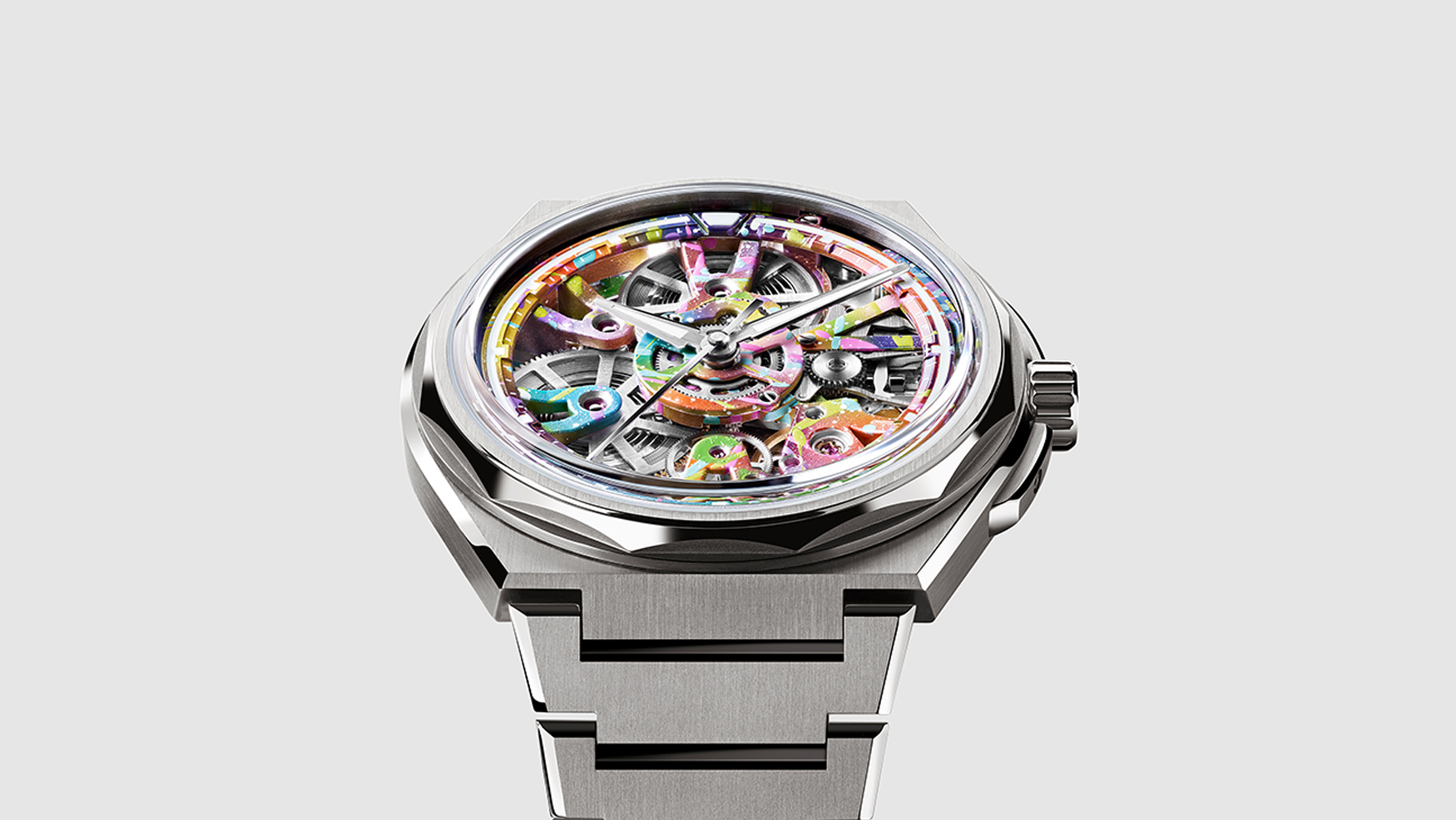
Christopher Ward Twelve Xander — limited to 150 pieces, each hand-painted by The Dial Artist. Image: © Christopher Ward
What Is the Christopher Ward Twelve Xander?
The Christopher Ward Twelve Xander is a limited edition of the brand's Twelve X — its skeletonised titanium flagship — created in full collaboration with Chris Alexander, known publicly as The Dial Artist. The name itself is a clue: "Twelve" for the watch series, "X" for the base model, and "ander" from Alexander's surname — fused into Xander.
The Twelve Xander is built upon the existing Twelve X platform, utilising its 41mm lightweight titanium case constructed from a combination of Grade 2 and Grade 5 titanium, measuring 12.3mm thick and 44.5mm lug-to-lug. It is housed behind flat sapphire crystals on both the front and back, with crown guards protecting the pushers. Available on either a fully integrated titanium bracelet or a white rubber strap, both integrated into the case seamlessly.
The launch event took place at the Windup Watch Fair in Chicago on July 9, followed by online availability on July 10 at 3:00 PM BST.
Who Is The Dial Artist?
Chris Alexander — The Dial Artist — is a British artist based in Perth, Scotland, who has become one of the most in-demand collaborators in contemporary watchmaking. His work takes the language of graffiti and street art — layered paint, overlapping colours, the apparent spontaneity of spray and brush — and applies it to watch dials and cases. Previous collaborations have included Bamford, Sartory-Billard, Holthinrichs, and Artisan D'horlogerie, as well as numerous custom pieces created for IFL Watches and charity auctions through Hands On Horology.
What makes the Christopher Ward Twelve Xander different from any of those is a structural one: there is no dial to paint. The Twelve X is fully skeletonised, which means the movement is the dial. For the first time, Alexander was asked to paint the movement itself — directly, on functioning mechanical components that would then be assembled into working watches.
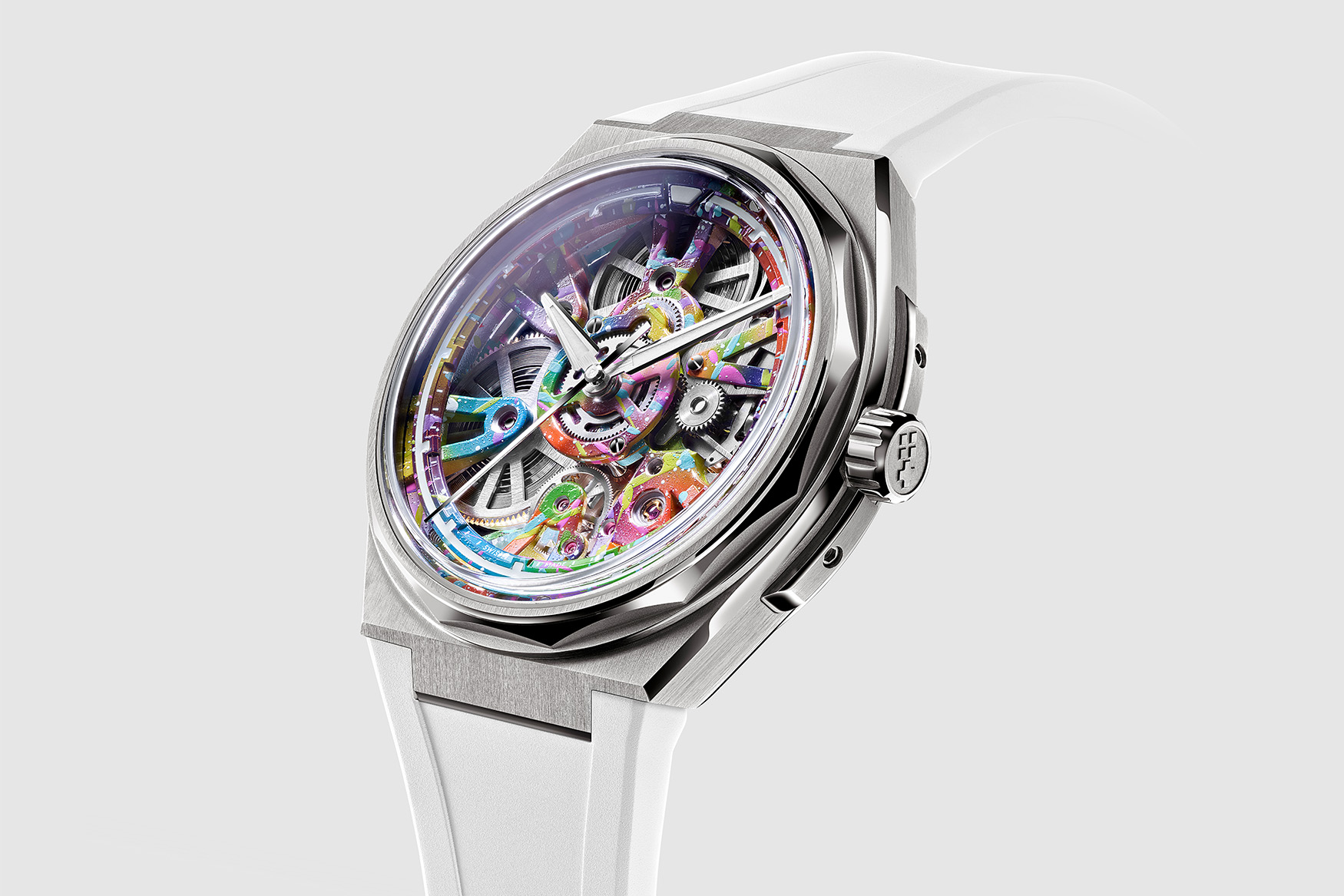
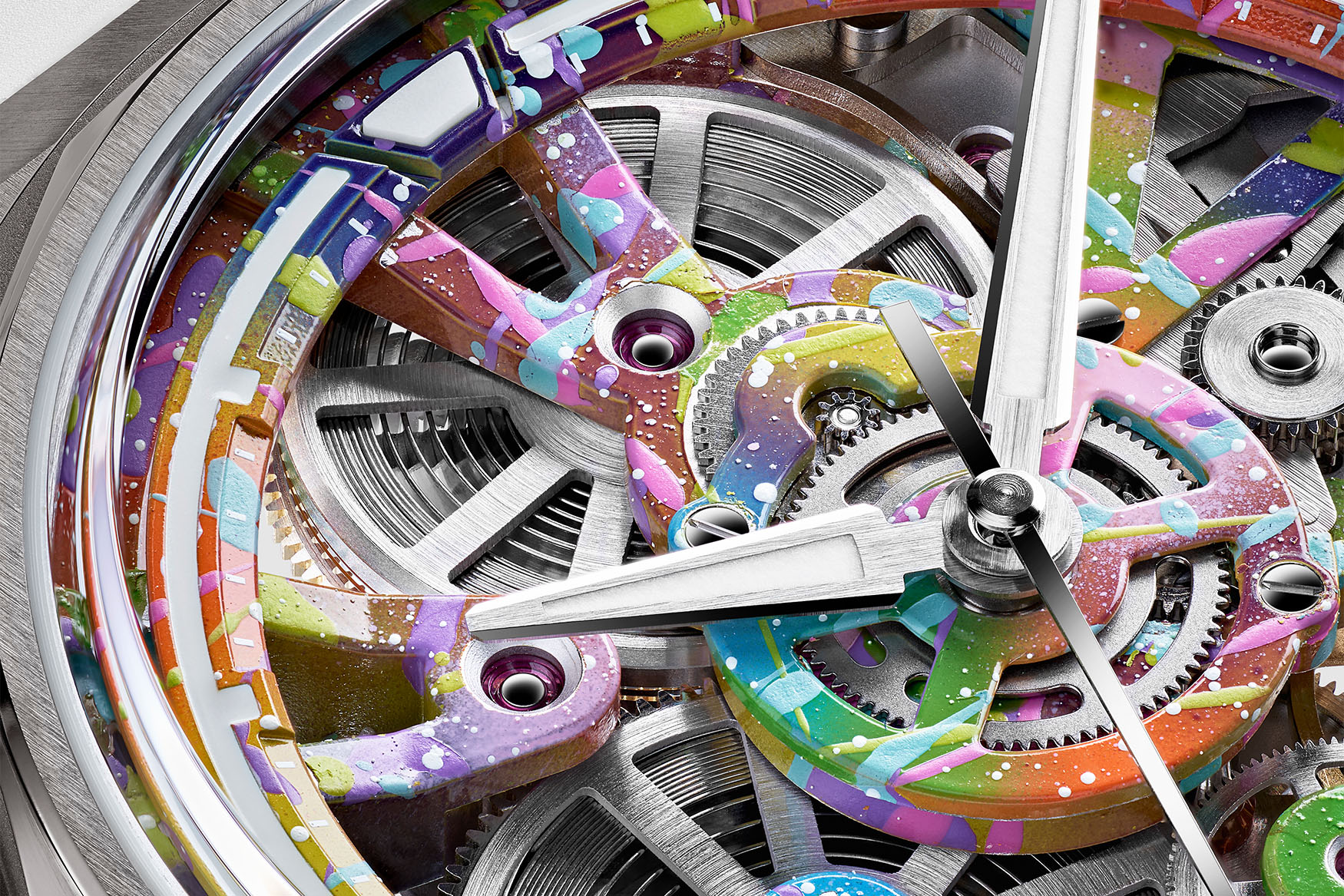
Front view: the hand-painted bridges, oscillating weight, and twin barrels visible through the full-skeletonisation dial. Image: © Christopher Ward
The Engineering Challenge: Painting a Working Movement
The Dial Artist is candid about what the project required: "It's meant to look chaotic. It's meant to look fast. It's meant to look as if I've just taken a paintbrush and splattered paint. I wish it were that easy." In practice, every component went through a rigorous multi-stage process — priming, airbrushing, hand-painting, and finishing — before being shipped from Perth to Christopher Ward's atelier in Biel, Switzerland.
The reason the Biel assembly stage is critical is tolerance control. Tolerances are particularly tight with a skeletonised movement like the CW-001, so factors like thickening paint and how that might impact the operation of the calibre had to be taken into consideration. Paint that is even fractions of a millimetre too thick on a bridge surface can compromise gear train performance. Every assembled watch was tested to confirm that the CW-001 still met its chronometer accuracy specifications — -4 to +6 seconds per day — before leaving the factory.
A total of 1,300 movement components were hand-painted for this collaboration. There are no shortcuts here, and it took approximately 900 hours to complete the painting process.
The result is a technical and artistic first. Oracle Time's review noted that it is difficult to find any precedent for a hand-painted movement in production watchmaking — even among the exceptional handcraft ateliers of Patek Philippe and Vacheron Constantin, both of which work with painted dials and enamelled cases but not with painted movement components that bear the full functional weight of a calibre.
The Colours: Controlled Chaos
The Christopher Ward Twelve Xander's palette runs through purple, blue, red, orange, pink, and green — with every shade in between — across the chapter ring, the calibre bridges, and the automatically winding rotor. The key aesthetic reference is 1960s action painting — the work of Jackson Pollock specifically, as Christopher Ward's own marketing material notes — and the cover of The Stone Roses' 1989 debut album, another image produced by an artist who used thrown and dripped paint to create something that reads as simultaneous chaos and intent.
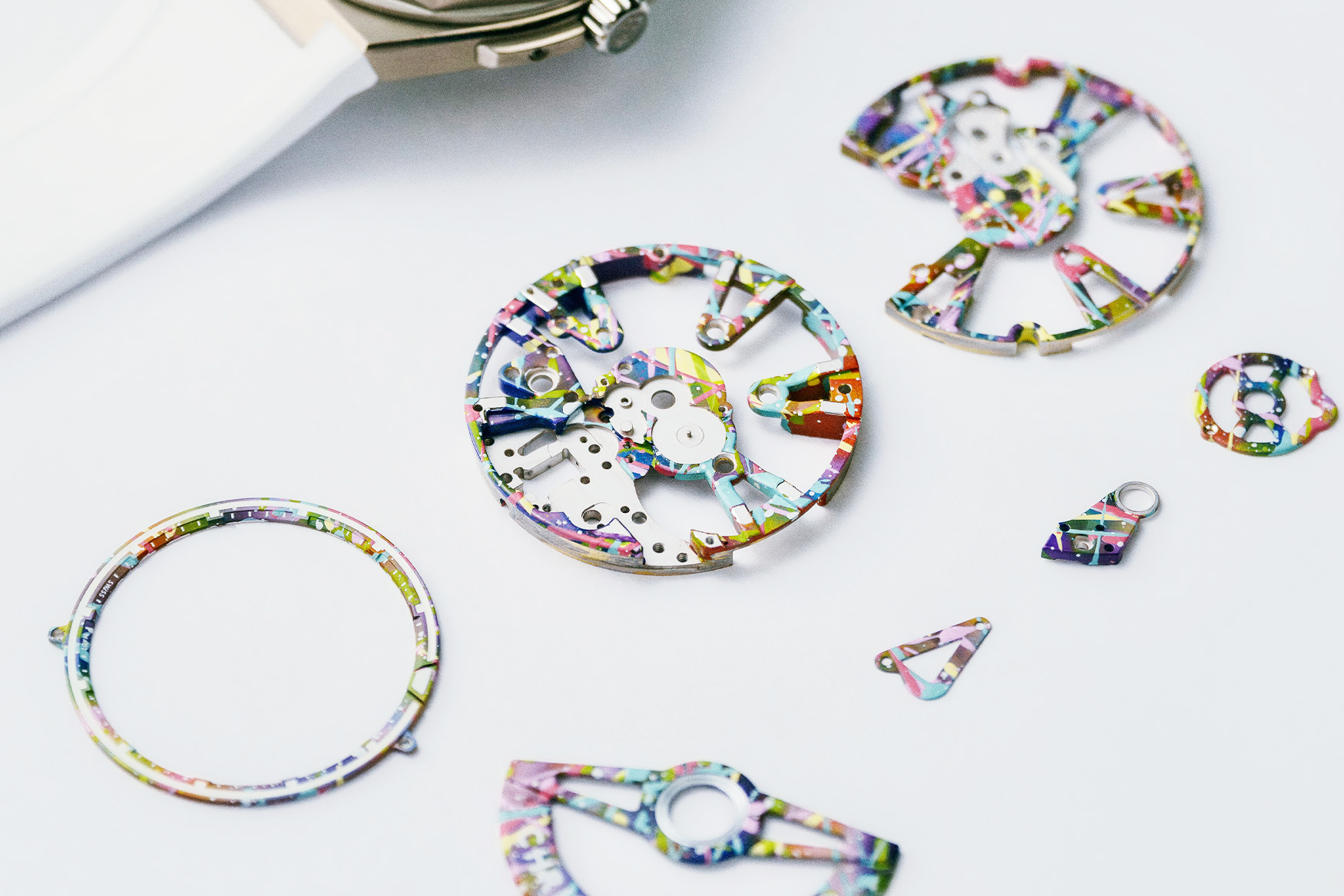
Caseback view: the decorated automatic winding rotor and painted bridges, visible through the exhibition sapphire. Image: © Christopher Ward
The white minute track on the dial side frames the painted movement without competing with it — giving the Christopher Ward Twelve Xander enough visual structure to be legible while letting the art remain the dominant experience. Super-LumiNova fills the hands for low-light visibility. The watch is readable; it is just not restrained.
The CW-001 Movement: First British Calibre in 50 Years
Christopher Ward launched the CW-001 calibre in 2014 — then called the SH21, under a different marketing era — as the first commercially viable mechanical movement from a British brand in 50 years. The CW-001 used in the Twelve Xander retains its twin-barrel architecture, delivering an impressive 120-hour (five-day) power reserve, operating at 28,800 vph (4Hz), and certified by COSC to within -4/+6 seconds per day. Both barrels are prominently visible through the dial's skeletonisation — one of the movement's most distinctive visual features even before the paint was applied.
The movement is automatic, with a bidirectional winding rotor that Alexander decorated as part of the project. It is visible through the flat sapphire caseback, which is itself one of the most appealing views of the Christopher Ward Twelve Xander — the rotor, as much as the dial-side bridges, shows Alexander's work at its most expressionistic.
Christopher Ward Twelve Xander: Full Specs
Reference: The Twelve Xander
Case diameter: 41mm
Case height: 12.3mm
Lug-to-lug: 44.5mm
Lug width: 25mm (integrated)
Case material: Grade 2 and Grade 5 titanium
Crystal: Flat sapphire (front and back)
Water resistance: 100m
Dial: Fully skeletonised, decorated by The Dial Artist across 8 visible components
Hands: Super-LumiNova-filled; white minute track
Movement: Christopher Ward Calibre CW-001, automatic (self-winding), COSC-certified
Frequency: 28,800 vph (4Hz)
Power reserve: 120 hours (twin barrels)
Accuracy: -4/+6 seconds per day
Decoration: 1,300 components hand-painted by The Dial Artist across 150 watches; 8 visible components painted per watch (bridges, chapter ring, oscillating rotor); 900 hours total work; 50 days
Weight: 102g (inc. strap)
Strap options: Integrated white rubber strap OR integrated titanium bracelet
Packaging: Eco-friendly luxury presentation case personalised with "The Dial Artist" branding; owner's handbook
Limited edition: 150 pieces (each unique — no two identical)
Price (rubber strap): $5,995 / £4,325 / €5,625
Price (titanium bracelet): $6,515 / £4,710 / €6,125
Available: July 10, 2026 at christopherward.com
How Much Does the Christopher Ward Twelve Xander Cost?
The Christopher Ward Twelve Xander is priced at $5,995 / £4,325 / €5,625 on the white rubber strap, and $6,515 / £4,710 / €6,125 on the integrated titanium bracelet. It is available directly through Christopher Ward's official website from July 10, 2026. Given the 150-piece production run and the fact that each watch is functionally unique, this is not a watch where waiting is wise.
The Twelve Xander on the integrated titanium bracelet. The 41mm case, 12.3mm profile, and 44.5mm lug-to-lug make it a genuinely wearable proposition. Image: © Christopher Ward
For context: the standard Twelve X (Ti) from which the Xander is derived starts at £3,940. The Xander's premium — roughly £385–£770 depending on configuration — reflects the 900 hours of handwork, the 150-piece limitation, and Alexander's growing reputation. The WatchTime review noted the art is applied directly to the movement — and the Fratello hands-on review specifically noted the watch was "hard to take off my wrist and send back" — a genuine endorsement from a publication that reviews thousands of watches a year.
Frequently Asked Questions
Q1. What is the Christopher Ward Twelve Xander?
A 150-piece limited edition of Christopher Ward's Twelve X skeleton watch, with movement components individually hand-painted by British artist Chris Alexander (The Dial Artist). Released July 10, 2026.
Q2. How much does the Christopher Ward Twelve Xander cost?
$5,995 / £4,325 / €5,625 on the rubber strap, or $6,515 / £4,710 / €6,125 on the titanium bracelet.
Q3. Are all 150 Christopher Ward Twelve Xander watches identical?
No. Each of the 150 watches has its own unique painted pattern — the abstract application of colour means no two watches share the same design. Christopher Ward describes the combinatorial uniqueness as "one in 2.56 quintillion."
Q4. What does "Xander" refer to in the name?
The name is a play on "Twelve X" (the base model) fused with "Alexander" — the surname of The Dial Artist (Chris Alexander). Twelve X + Alexander = Twelve Xander.
Q5. Is the Christopher Ward Twelve Xander movement automatic or manual?
Automatic. The CW-001 calibre features a bidirectional automatic winding rotor, which Alexander also painted as part of the collaboration. It is visible through the exhibition caseback.
Q6. Where was the painting done?
Chris Alexander painted all components at his studio in Perth, Scotland. The painted parts were then shipped to Christopher Ward's watchmaking atelier in Biel, Switzerland, for assembly and COSC testing.
The Bottom Line
The Christopher Ward Twelve Xander is the kind of release that genuinely moves the creative conversation in watchmaking forward. A skeletonised movement is not a new idea. A collaboration with an artist is not a new idea. But painting a functioning mechanical movement before assembly — with paint layers thin enough to preserve the tolerances of a COSC-certified calibre — is something that has not been done in production watchmaking before, by any brand at any price. Christopher Ward had the in-house movement to make it possible and a genuine brief for Alexander rather than a surface-level vanity project. The result is 150 watches, each one different, each one documenting a specific moment of Alexander's work in a medium — mechanical timekeeping — that preserves it permanently. For the full Fratello hands-on, Jorg Weppelink's review covers the wrist experience in detail. For more art-driven watchmaking, see our art watches guide and our skeleton watch guide.