
The best regulator watches do something no other watch category does: they split hours, minutes, and seconds onto completely separate axes, giving each hand its own dedicated scale and its own position on the dial. The result is a display that can take a moment to read the first time — but once you understand it, reads with extraordinary precision. Regulator watches are a niche within a niche, embraced by a handful of brands with distinct design identities and sold to collectors who know exactly what they want. This guide covers six of the best regulator watches available in 2026, ranging from a $1,295 entry point to Patek Philippe's $59,510 annual calendar complication — and every significant aesthetic approach to the format in between.
For more specialist watch guides, see our watch buying guides archive and our Chronoswiss watch guide. Here is everything you need to know.
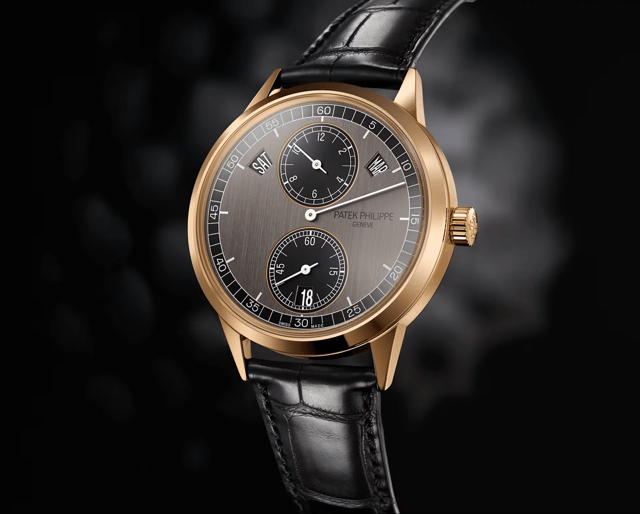
The regulator display: hours, minutes, and seconds each on their own separate axis. Image: © Patek Philippe via WatchTime
What Is a Regulator Watch?
Before choosing from the best regulator watches, it helps to understand where the format comes from. A regulator — historically spelled "régulateur" in French — was a precision master clock used as a reference timepiece in workshops, factories, observatories, and railroad stations. Its defining feature was a split display: the minute hand dominated the centre of the dial, while a small hour sub-dial sat at 12 o'clock and a seconds sub-dial sat at 6 o'clock. The separation meant each indication could be read precisely without ambiguity — a critical quality when technicians were synchronising pocket watches to an exact time standard.
Chronoswiss was the first brand to translate this format into a commercially produced wristwatch, launching its Régulateur in 1987. Since then, the layout has been adopted and reinvented by brands from Junghans to Patek Philippe, each bringing their own visual language to a format that is both historically grounded and visually distinctive.
What Makes the Best Regulator Watches Special?
The best regulator watches share one structural truth: the minute hand is always the star. Unlike a conventional watch, where hours and minutes share a central pinion and dominate the dial equally, a regulator demotes the hour to a peripheral sub-dial and elevates the central minute hand to the primary reading surface. It is a small philosophic shift — minutes matter more than hours — that produces a dramatically different visual result.
Beyond that shared structure, the best regulator watches diverge sharply. Some interpret the format classically, with white dials and blued hands evoking precision instruments of the 18th century. Others treat it as a vehicle for radical design — horizontal alignments, rotating sub-dials, deconstructed layouts. The six below represent the full range.
1. Hamilton Jazzmaster Regulator Cinema — $1,295
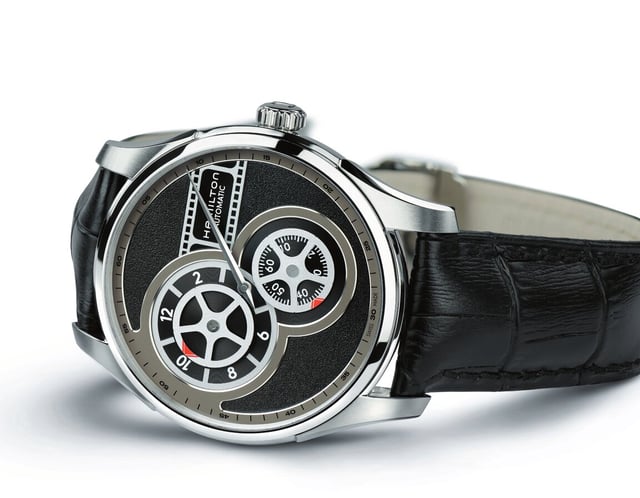
Hamilton Jazzmaster Regulator Cinema — hours and seconds presented as rotating film "reels." Image: © Hamilton via WatchTime
The most accessible of the best regulator watches on this list is also one of the most original. When Hamilton creates a regulator, it allows itself a sense of play. Drawing on the brand's long relationship with Hollywood — from Elvis Presley wearing the Ventura in Blue Hawaii (1961) to a futuristic reinterpretation seen in Dune: Part Two — Hamilton looked to film for inspiration. The layout presents hours and seconds as rotating "reels" reminiscent of vintage cameras, while the minute hand remains centrally mounted.
Details reinforce the concept, including the Hamilton name rendered as a strip of film on the dial, echoed again on the transparent caseback insert. The Jazzmaster Regulator Cinema is housed in a 42mm stainless-steel case and powered by automatic Caliber H-12, based on the ETA 2825-2.
At $1,295, this is the entry point for anyone curious about regulator watches without the commitment of a five-figure investment. The Fratello team's broader five best regulator watches guide provides useful additional context. The Cinema edition makes it genuinely entertaining to wear — the reel metaphor lands well both visually and intellectually.
Price: $1,295
2. Junghans Max Bill Regulator Edition 60 — $2,400
Junghans and Max Bill began their collaboration in 1961 — one of the most celebrated partnerships between a watch brand and a designer in the post-war era. The Regulator Edition 60 celebrates that legacy with the same clarity and balance that defined the originals. The regulator layout is nearly perfectly symmetrical, with every element placed with measured precision. Rather than feeling clinical, the design appears harmonious and calm.
A subtle orange accent marks "60" at 12 o'clock, echoed by Super-LumiNova-filled hands. The matte white dial contrasts beautifully with the anthracite PVD-coated case, while the light-gray strap features an orange lining that ties the design together. Inside beats automatic Caliber J800.5. The Max Bill Regulator Edition 60 is limited to 1,060 pieces.
If the Hamilton is a playful take on the regulator format, the Junghans is a scholarly one — Bauhaus principles applied to a mechanical platform that was already precision-oriented. The orange accents are the only concession to warmth; everything else is rigorous. At $2,400, it is one of the best regulator watches for anyone drawn to German design discipline.
Price: $2,400
3. Louis Erard Le Régulateur Grand Feu Enamel — CHF 4,500
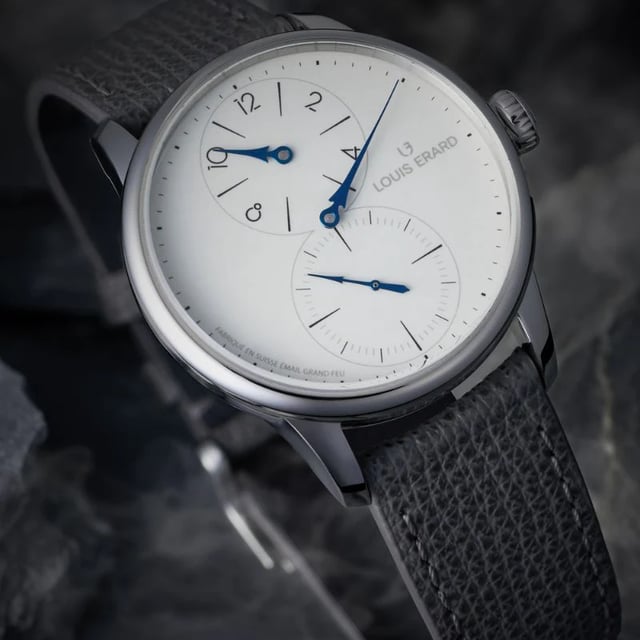
Louis Erard Le Régulateur Grand Feu Enamel — the traditional format executed with historical authenticity. Image: © Louis Erard via WatchTime
Louis Erard has arguably done more for the modern regulator than any brand other than Chronoswiss, launching a major collaborative series in 2019 that has since produced nearly ten editions with artists including Alain Silberstein, Vianney Halter, and Cédric Johner. The Le Régulateur Grand Feu Enamel is among the most restrained — at least at first glance. Three blued steel hands sweep across what appears to be a simple white dial, but closer inspection reveals grand feu enamel.
This traditional material suits the regulator's historical roots, while the modern hand shapes and markings keep the design firmly contemporary. The 39mm stainless-steel case strikes an ideal balance between vintage proportion and modern wearability. Power comes from the Sellita SW266-1, offering a 38-hour power reserve. A gray grained calfskin strap completes the understated aesthetic. Limited to 99 pieces.
Grand feu enamel — kiln-fired in multiple layers at temperatures above 800°C — is one of watchmaking's most demanding traditional techniques, and pairing it with a regulator display makes historical sense: both originate from the same era of precision instrument-making in Europe.
Price: CHF 4,500
4. Chronoswiss Strike Two Golden Gear — $10,800
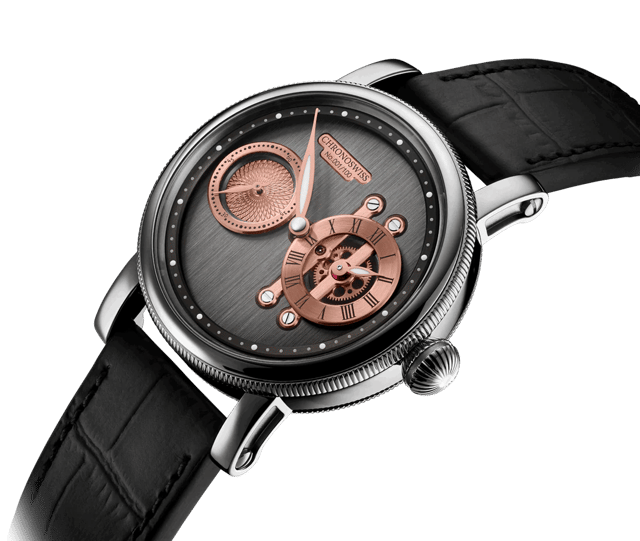
Chronoswiss Strike Two Golden Gear — a horizontal regulator from the brand that invented the format for wristwatches. Image: © Chronoswiss via WatchTime
Chronoswiss can rightly be called the godfather of modern regulator watches, having been the first brand to produce them in series in 1987. Since then, the regulator layout has become central to its identity. The Strike Two Golden Gear is the brand's most provocative take yet on its own signature.
Its most notable feature is the horizontal alignment of the hand axes — a departure from the more common vertical arrangement. Hand guilloché, contrasting materials, and intricate finishing underscore the watch's craftsmanship, while the 40mm case remains comfortably wearable. Inside is the new Caliber C.6000, developed with La Joux-Perret. Limited to 100 pieces, though Chronoswiss history suggests the design may eventually join the regular collection.
Where most regulators read vertically — hours at 12, seconds at 6, minutes in the centre — the Strike Two reads horizontally, with hours open-worked at 3 o'clock and seconds in a guilloché counter at 9. The central minute hand is the only constant. It is a fundamentally different spatial experience for the same underlying principle.
Price: $10,800 (limited to 100 pieces)
5. Garrick Regulator MKII — from GBP 9,995
At Garrick, British watchmaking traditions are upheld with remarkable dedication. Based in Norfolk, a small team led by David Brailsford and Simon Michlmayr produces watches largely by hand, including many in-house components. The Regulator MKII exemplifies Garrick's unconventional approach. Dominated visually by the Trinity free-sprung balance, the subdials for hours and seconds are positioned in unexpected locations. This deliberate quirkiness enhances the watch's exclusivity and character.
Each Regulator MKII is made to order, with extensive customization options — particularly in dial colour and finish — reflecting Garrick's artisanal production methods.
The Garrick sits in a part of the market where rarity and craftsmanship are the proposition rather than brand recognition. Garrick watches are rarely discussed in major publications, which is part of their appeal to collectors who prioritise the object over the logo. The Regulator MKII is made specifically for you: your dial colour, your finishing, your specification. That is a genuinely unusual offer in any watch category, let alone among the best regulator watches.
Price: From GBP 9,995 (made to order)
6. Patek Philippe Ref. 5235/50R — $59,510
With the Ref. 5235/50R, Patek Philippe presents a refined take on the regulator display. The two-tone ebony black and graphite dial is paired with white transfer-printed scales and white-coated hands for exceptional legibility. Beyond the regulator layout, Patek integrates its signature annual calendar complication. Day, date, and month windows are carefully spaced to preserve symmetry. The 40.5mm case is crafted from 18k pink gold, adding warmth and contrast.
Through the sapphire caseback, the micro-rotor movement reveals finely finished bridges, along with advanced components developed by Patek Philippe Advanced Research, including the Silinvar Spiromax balance spring and Pulsomax escapement.
First introduced in 2011 and refined over subsequent iterations, the 5235 is Patek's only annual calendar regulator — and the annual calendar integration is significant. The three apertures for day (at 10 o'clock), month (at 2 o'clock), and date (at 6 o'clock) are arranged so they reinforce the regulator's separated display rather than fighting it for visual space. The Silinvar and Pulsomax components from Patek's Advanced Research division, normally reserved for grand complications, are present here — making this considerably more technically ambitious than its understated presentation suggests.
At $59,510, the 5235/50R is the definitive answer to anyone who asks what the best regulator watch looks like at no-compromise level.
Price: $59,510
Best Regulator Watches: Prices at a Glance
Hamilton Jazzmaster Regulator Cinema: $1,295 — 42mm, automatic, film reel sub-dials
Junghans Max Bill Regulator Edition 60: $2,400 — limited 1,060 pieces, Bauhaus design
Louis Erard Le Régulateur Grand Feu Enamel: CHF 4,500 — 39mm, 99 pieces, traditional enamel
Chronoswiss Strike Two Golden Gear: $10,800 — 40mm, 100 pieces, horizontal layout, C.6000
Garrick Regulator MKII: from GBP 9,995 — bespoke, made to order, in-house
Patek Philippe Ref. 5235/50R: $59,510 — 40.5mm, 18k rose gold, annual calendar, Silinvar
Frequently Asked Questions
Q1. What is a regulator watch?
A regulator watch separates hours, minutes, and seconds onto independent non-coaxial axes, each with its own scale and sub-dial. The central minute hand is dominant; hours typically appear at 12 o'clock and seconds at 6 o'clock. The format originated in precision master clocks used to synchronise other timepieces in workshops and observatories.
Q2. Which brand invented the wristwatch regulator?
Chronoswiss, founded in 1983 by Gerd-Rüdiger Lang in Munich, produced the first commercially available series-production regulator wristwatch in 1987. The format has been central to the brand's identity ever since.
Q3. Are regulator watches harder to read?
Initially, yes — the separated display takes some adjustment, particularly reading hours from a sub-dial rather than a central hand. Most people adapt within a few days of wearing one. The precision gain is that each hand can be read independently, without any ambiguity from adjacent hands on a shared axis.
Q4. What is the best regulator watch for a first-time buyer?
The Hamilton Jazzmaster Regulator Cinema at $1,295 is the most accessible entry point with a coherent design concept. The Junghans Max Bill Regulator Edition 60 at $2,400 is the better choice for anyone who prioritises design purity over novelty. Both are genuine best regulator watches at their price point.
Q5. What makes the Patek Philippe 5235 special among regulator watches?
It is the only Patek complication to combine a regulator display with the annual calendar — and the only annual calendar in the Patek lineup to use Silinvar (silicon-derived) Advanced Research components from outside the Grand Complications. It is Patek's most technically ambitious everyday complication.
Q6. Is the Chronoswiss Strike Two limited edition?
Yes, the Strike Two Golden Gear is limited to 100 pieces per edition, though Chronoswiss has historically brought its strongest Strike Two designs into the permanent collection after the initial limited run.
The Bottom Line
The best regulator watches in 2026 are a genuinely diverse group. They share a structural principle — minutes central, hours and seconds elsewhere — and diverge in every other direction: price, material, aesthetic philosophy, and production method. Hamilton makes the regulator playful. Junghans makes it rigorous. Louis Erard makes it historical. Chronoswiss makes it architectural. Garrick makes it personal. Patek Philippe makes it inevitable. Whether you are spending £1,000 or $60,000, the regulator format rewards the kind of attention that most watch designs never receive. For more on the format's history and technical context, WatchTime's definitive regulator guide is the most thorough single source available. For a broader look at the most innovative watch displays, see our complications guide. For more on Louis Erard's evolving regulator lineup, see the brand's official regulator collection page.