
The H. Moser Endeavour Flyback Chronograph Dual Time Date packs a flyback chronograph, a second time zone, and a date display into a single 42mm steel case — with no subdials, no visible logo, and almost nothing on the dial to suggest three separate complications are running underneath. Unveiled on May 27, 2026, it's powered by an entirely new hand-wound caliber, the HMC 730, developed with longtime movement partner Agenhor, and it joins H. Moser & Cie.'s permanent collection rather than arriving as a limited edition.
It's the brand's second major move this year toward bringing its AgenGraphe-derived chronograph architecture out of the avant-garde Streamliner line and into its more classical Endeavour collection — and the result might be the cleanest-looking flyback chronograph H. Moser has ever made. Here's everything worth knowing: how it works, what's inside it, what it costs, and why watch journalists keep calling it “deceptively simple.”
What Is the H. Moser Endeavour Flyback Chronograph Dual Time Date?
The H. Moser Endeavour Flyback Chronograph Dual Time Date, reference 1730-1200, is the newest addition to H. Moser & Cie.'s Endeavour collection — historically the brand's more restrained, dress-watch-leaning line, as opposed to the sportier, more sculptural Streamliner. What makes this release notable is what it brings into that classical case: a column-wheel flyback chronograph, an integrated second time zone, and a date function, all read from a single centralized display with zero subdials.
That centralized layout traces back to the AgenGraphe movement architecture H. Moser developed with Agenhor — the Geneva-based complications specialist founded by Jean-Marc Wiederrecht — first introduced on the Streamliner Flyback Chronograph back in 2020. In 2023, MELB, the Meylan family holding company that owns H. Moser & Cie., Hautlence, and hairspring specialist Precision Engineering AG, took a stake in Agenhor directly, deepening an already close partnership. The Endeavour Flyback Chronograph Dual Time Date is the most refined product of that relationship to date, and the first time this chronograph concept has been built specifically for the Endeavour case rather than ported over from the Streamliner.
A Dial With Almost Nothing On It
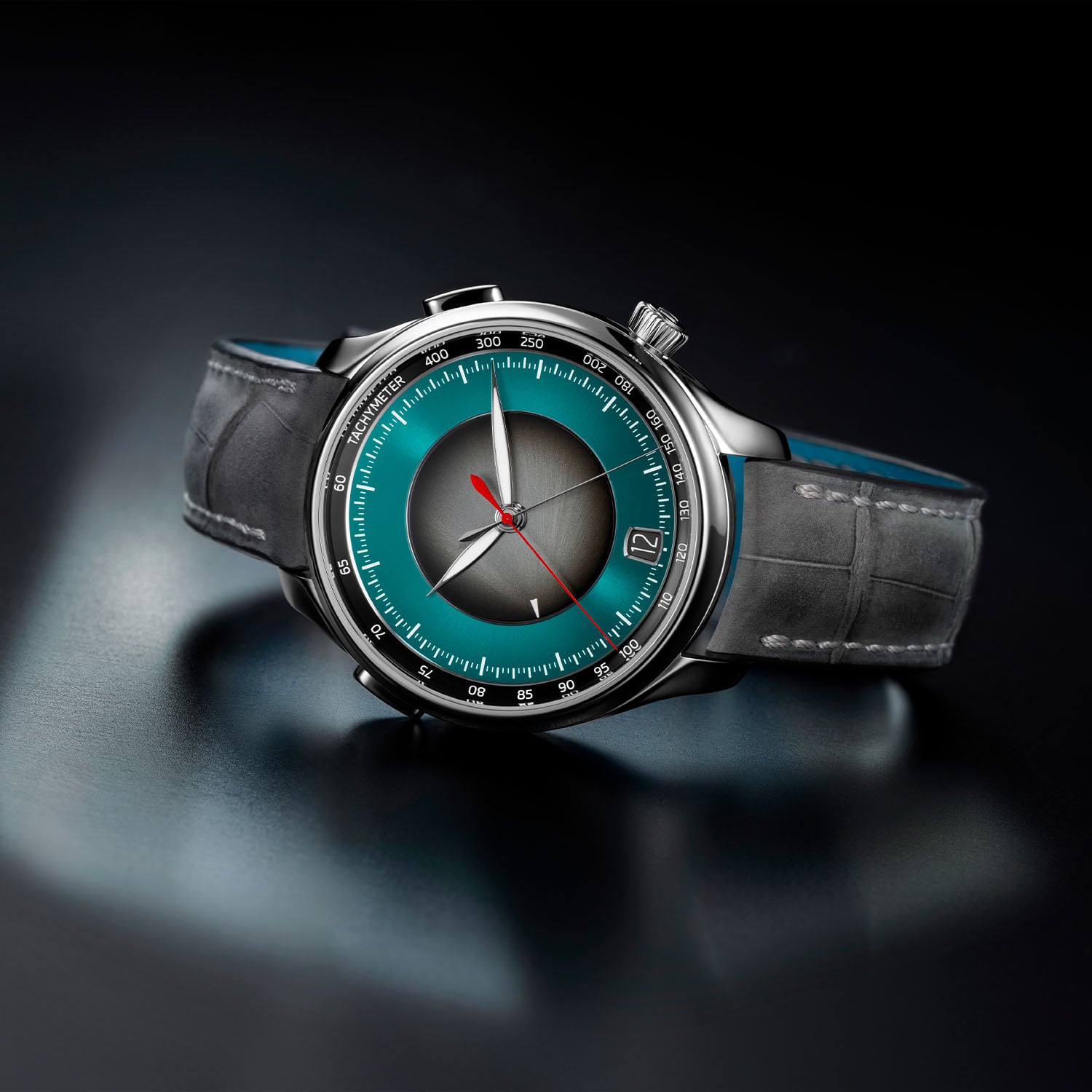
H. Moser's whole identity is built around doing more with less, and this watch pushes that philosophy about as far as a triple-complication chronograph reasonably can. The dial is split into two concentric zones: an outer ring in turquoise fumé with a sunburst finish, and a central disc in a darker grey-to-black “Blackor” fumé, both entirely free of branding.
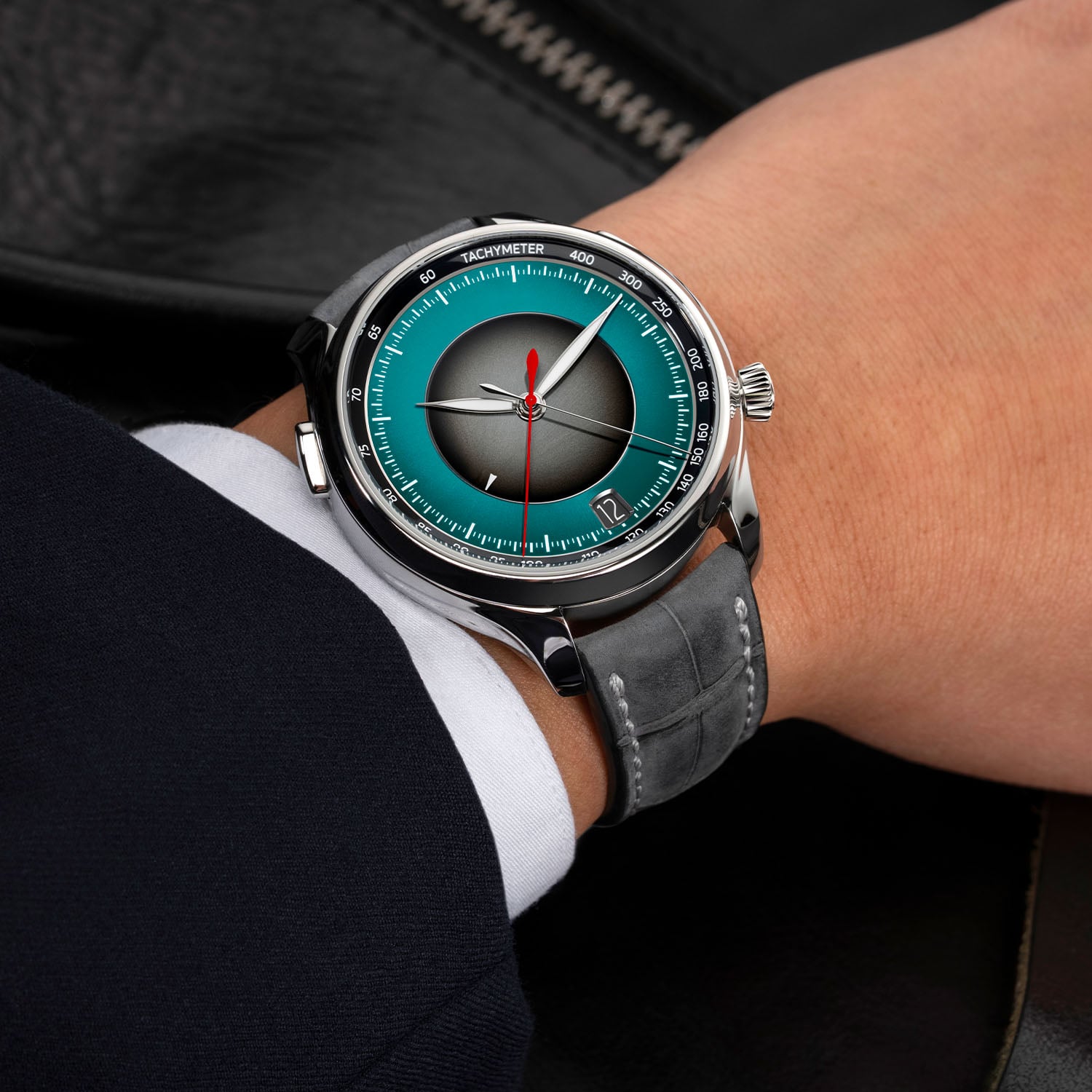
Every indication lives in that centralized space. A red hand tracks the chronograph seconds, while a rhodium-plated hand tracks elapsed minutes around a white peripheral track — interrupted only by a date window at 6 o'clock. The black flange carries a tachymeter scale for speed calculations. The second time zone is shown via a white Super-LumiNova arrow on the central Blackor disc, and leaf-shaped hour and minute hands, also lumed, round out the display. There isn't a single subdial anywhere on the watch — every function is read from roughly the same central point your eye already rests on.
Inside the HMC 730: A New Hand-Wound Movement Built From an Automatic One
The most technically interesting part of this release isn't visible at a glance: H. Moser converted an automatic chronograph movement into a manually wound one specifically to make room for more functions. The new caliber HMC 730 is built on the architecture of the HMC 902 — the automatic AgenGraphe-based movement used in the Streamliner Flyback Chronograph — but strips out the automatic winding system and oscillating weight entirely.
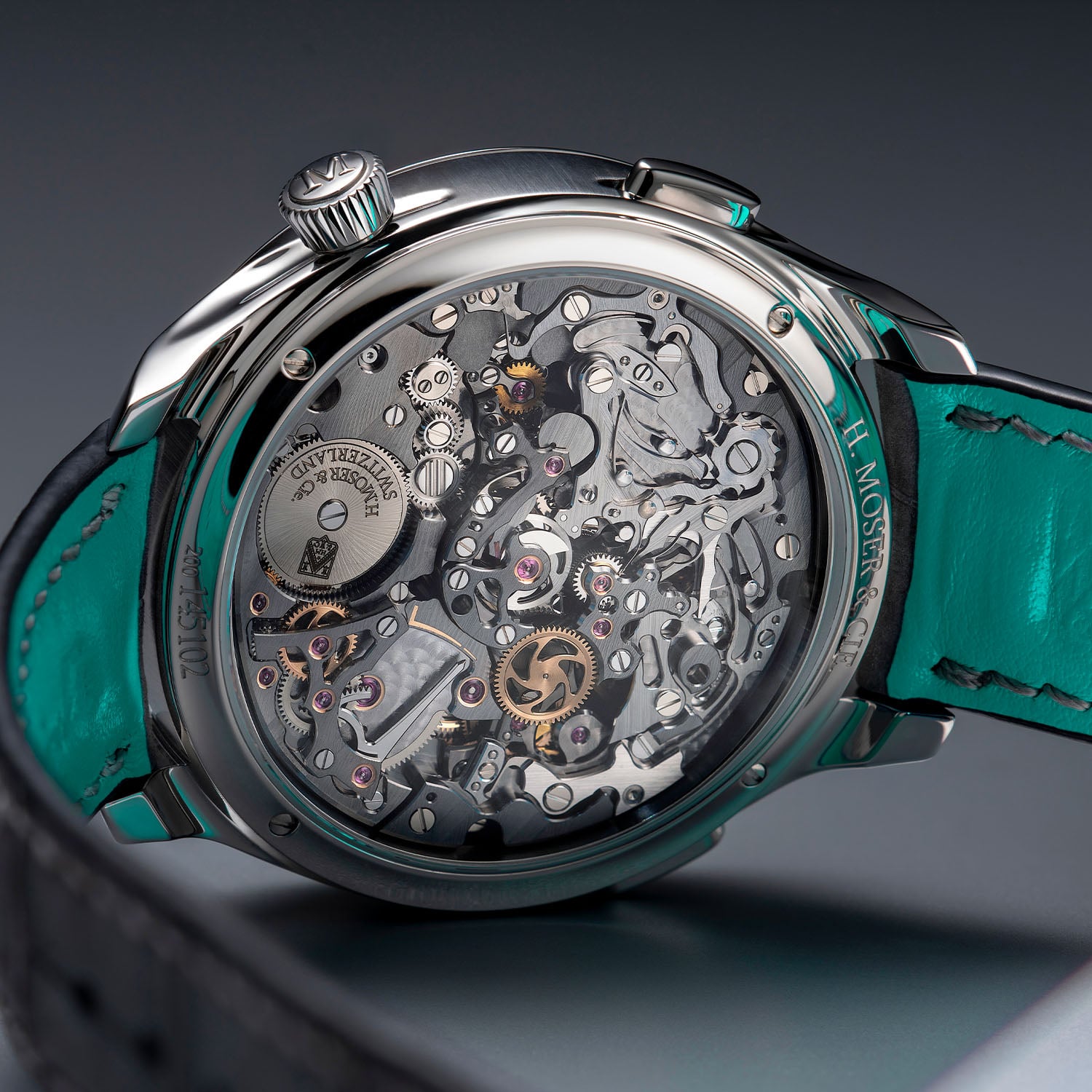
Removing the rotor freed up the architectural space needed to integrate the dual-time and date functions without crowding the movement or the dial. The HMC 730 keeps the defining features of the AgenGraphe concept: a column-wheel-controlled chronograph and Agenhor's patented micro-tooth horizontal clutch, designed to eliminate the slight jumping motion typically associated with conventional horizontal-clutch chronographs. The chronograph's elapsed-minute display uses a retrograde mechanism built around a snail cam, letting that central minute hand jump instantly to its new position rather than creeping forward — a detail aimed squarely at making elapsed time easier to read at a glance.
The movement runs at 21,600 vibrations per hour (3Hz), stores 72 hours of power across twin barrels, and tucks its power reserve indicator onto the movement side specifically to keep the dial uncluttered. Finishing includes anthracite treatment, perlage, H. Moser's signature double-stripe motif, and partially skeletonized bridges, all visible through a sapphire exhibition caseback.
H. Moser Endeavour Flyback Chronograph Dual Time Date: Specs at a Glance
Category Detail Reference1730-1200 AnnouncedMay 27, 2026 CasePolished stainless steel, 42mm × 13.2mm CrystalSapphire, front and back Water resistance30m Crown & pushersScrew-down crown at 4 o'clock; chronograph pushers at 10 and 2 o'clock DialTurquoise fumé outer ring, Blackor fumé central GMT disc, tachymeter flange MovementCaliber HMC 730, developed with Agenhor WindingHand-wound (manual) FunctionsHours, minutes, flyback chronograph, second time zone, date, power reserve Frequency21,600 vph (3Hz) Power reserve72 hours (twin barrels) Components383 StrapGrey nubuck-finished alligator leather, steel pin buckle Limited editionNo — permanent collection piece PriceCHF 59,000 excluding VAT
How Much Does the H. Moser Endeavour Flyback Chronograph Dual Time Date Cost?
H. Moser lists the Endeavour Flyback Chronograph Dual Time Date at CHF 59,000 excluding VAT, confirmed directly on the brand's own product page. That places it well above the entry tier of the Endeavour line but in line with what a manufacture-level chronograph with this much integrated complexity typically commands from an independent brand of Moser's standing. Final retail pricing will vary by market once local taxes and import duties are factored in — in India, for instance, retailer Ethos lists the piece at roughly ₹75,20,000.
It's worth noting that a handful of outlets reported a notably higher figure around CHF 74,500 / $74,400 shortly after launch; that number doesn't reconcile with H. Moser's own published price or with regional retail listings once local duties are accounted for, so it appears to be a press-materials mix-up that circulated across a few sites. CHF 59,000 excluding VAT is the figure confirmed on H. Moser's official site.
The watch isn't a limited edition, which matters for a brand whose annual output is already small — H. Moser has confirmed this is a permanent addition to the Endeavour collection rather than a one-off, so availability should improve over time through boutiques and authorized dealers rather than disappearing in a single allocation round.
How It Fits Into H. Moser's Broader Chronograph Strategy
This isn't H. Moser's first attempt at hiding a chronograph's complexity behind a clean dial — that idea started with the Streamliner Flyback Chronograph in 2020, which paired the automatic AgenGraphe-based HMC 902 with the brand's distinctive integrated-bracelet sports case. The Endeavour Flyback Chronograph Dual Time Date takes the same underlying philosophy and applies it to a more classically proportioned watch, while also pushing the engineering further by adding dual-time functionality and converting the movement to hand-wound in the process.
It's also part of a pattern: earlier in 2026, H. Moser took a similar approach with the Streamliner Pump, built around the HMC 103 — a manually wound version of the brand's workhorse automatic HMC 500. Converting automatic movements to hand-wound configurations specifically to unlock additional functions appears to be becoming a recurring engineering strategy at Moser, not a one-off experiment.
Frequently Asked Questions
Q1. How much does the H. Moser Endeavour Flyback Chronograph Dual Time Date cost?
CHF 59,000 excluding VAT, per H. Moser's official pricing. Final retail price varies by market once local taxes and duties are applied.
Q2. What movement powers the H. Moser Endeavour Flyback Chronograph Dual Time Date?
The hand-wound caliber HMC 730, developed with Agenhor. It runs at 21,600 vph, stores 72 hours of power reserve across twin barrels, and has 383 components.
Q3. Is the H. Moser Endeavour Flyback Chronograph Dual Time Date a limited edition?
No. It's a permanent addition to H. Moser's Endeavour collection, not a limited run.
Q4. What complications does this watch have?
A flyback chronograph with column-wheel control, a second time zone shown on a central rotating disc, a date display, and a power reserve indicator — all without a single subdial.
Q5. How is the HMC 730 different from the movement in the Streamliner Flyback Chronograph?
The HMC 730 is built on the same AgenGraphe-based architecture as the Streamliner's automatic HMC 902, but H. Moser removed the automatic winding rotor entirely and converted it to hand-wound, freeing up space to add the dual-time and date functions.
Q6. What size is the case?
42mm in diameter and 13.2mm thick, in polished stainless steel, with 30m of water resistance.
The Bottom Line
The H. Moser Endeavour Flyback Chronograph Dual Time Date is a watch that asks you to take its restraint at face value and then rewards you for looking closer. Three genuinely demanding complications — flyback chronograph, dual time, date — are folded into a dial with no subdials and no branding, powered by a movement that H. Moser quite literally rebuilt from scratch by removing its automatic winding system. At CHF 59,000 excluding VAT, it isn't cheap, but it occupies a fairly unusual spot in the market: a hand-wound, manufacture-level chronograph with this much going on, from a brand that's never been interested in making its complications look complicated.
What do you think - does the minimalist approach work better here than it did on the Streamliner? Let us know in the comments, and subscribe for more first looks at the latest from H. Moser & Cie. and other independent watchmakers.