
The Bulova Lunar Pilot Black Hole (ref. 98A335) is the answer to the single most requested change in Bulova's modern history: a 41mm version of the Lunar Pilot. The Bulova Lunar Pilot Black Hole trims the case from the longstanding 43.5mm to a far more wearable 41mm, wraps every surface in matte black PVD, and coats the dial in Musou Black — a specialty paint that absorbs 99.4% of visible light — giving the watch its name in two different ways. It launched on April 28, 2026, limited to 6,000 pieces worldwide, and carries a retail price of $1,650 / £1,250. It comes paired with a desk clock and travel case in a special box themed around the Apollo 15 mission.
This is not a simple colourway update. The Bulova Lunar Pilot Black Hole represents the first meaningful case-size change to the Lunar Pilot in over a decade, the first time Musou Black has been used on a Bulova dial, and one of the most compelling entry-point space chronographs available in 2026. For more from the Bulova collection, see our Bulova watches archive and our chronograph buying guide. Here is everything worth knowing.
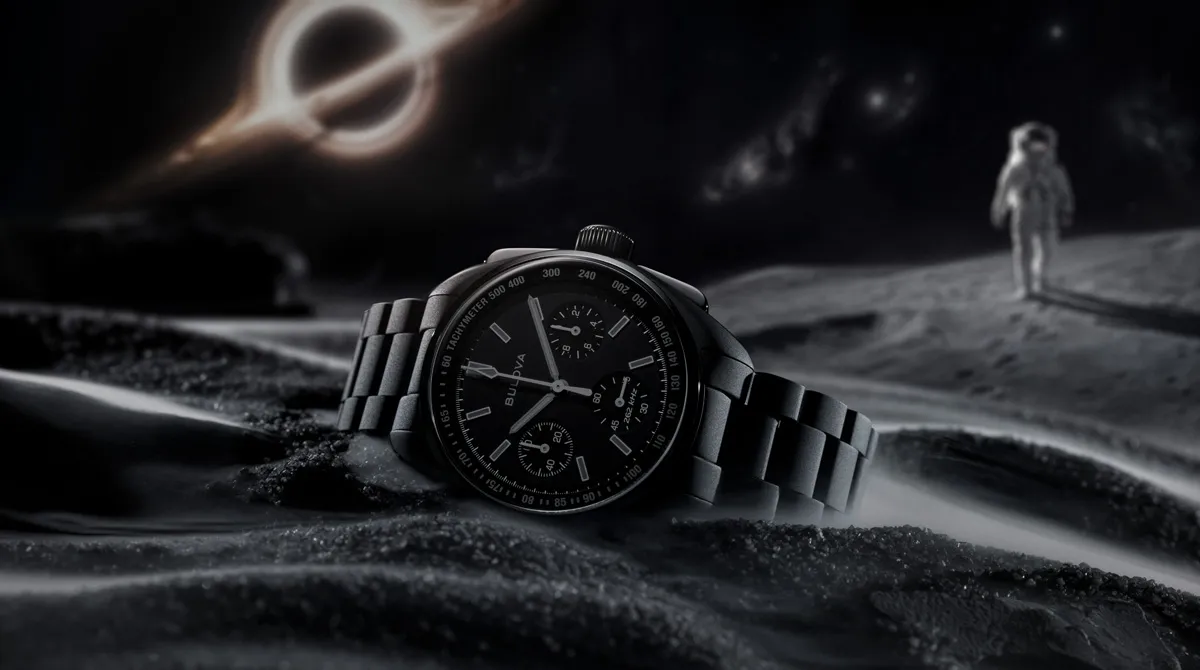
The Apollo 15 Story Behind the Bulova Lunar Pilot Black Hole
To understand why Bulova named this watch "Black Hole," you need to know what happened on August 2, 1971, during the third and final moonwalk of the Apollo 15 mission.
Commander David R. Scott was preparing for his third EVA (extravehicular activity) on the lunar surface. NASA had issued him an Omega Speedmaster Professional — the standard equipment for all Apollo astronauts. By the third moonwalk, Scott's Speedmaster had lost its crystal, rendering it unreliable as a precision timing instrument. Under certain operational conditions on the lunar surface, the only way to monitor oxygen levels, water supplies, and battery life was with a wrist chronograph. Scott needed a working watch. He reached for his backup — a Bulova chronograph he had packed himself as private equipment, not listed on the official manifest.
The Bulova was used to time Lunar Roving Vehicle excursions, monitor life-support systems, and assist with spacecraft re-entry calculations. It performed exactly as a tool watch should. Then the mission reports came back, and the brand name had been redacted from every document. For years, the entry read only that a "second chronograph" had been used. A black hole, it turns out, can consume information as effectively as it consumes light. It eventually emerged that the watch was a Bulova, and the brand celebrated the achievement through the Lunar Pilot collection. The original David Scott Bulova fetched $1.625 million at auction in 2015.
The Bulova Lunar Pilot Black Hole takes its name directly from that suppression of history — the information that was made to disappear from the official record. It's one of the most specific and genuinely earned product names in recent watchmaking.
What Is the Bulova Lunar Pilot Black Hole?
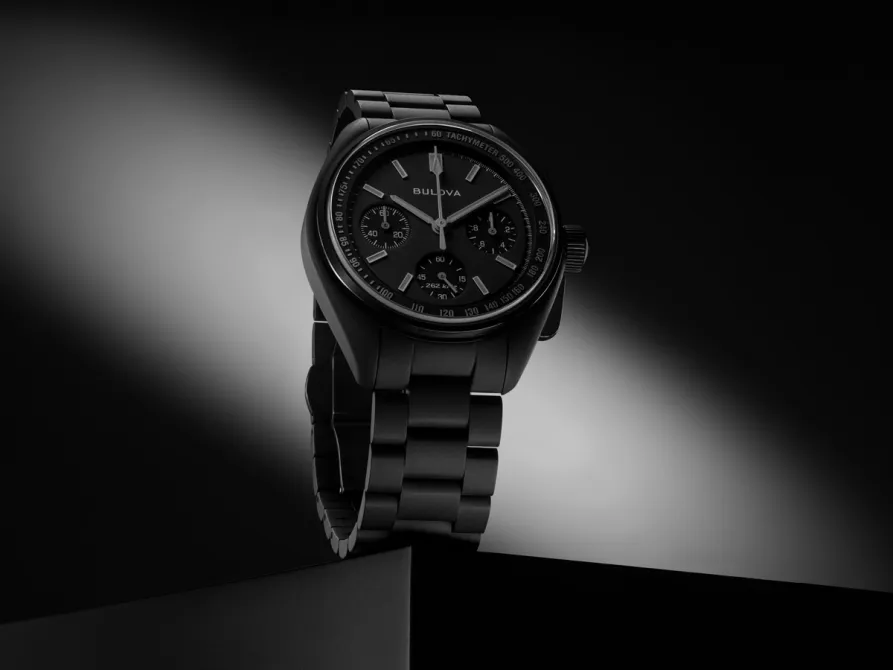
The Bulova Lunar Pilot Black Hole is the first Lunar Pilot to arrive in a 41mm case — a 2.5mm reduction from the current 43.5mm standard. It retains the cushion-shaped profile that links the modern Lunar Pilot to the 1971 original, but the smaller diameter brings the lug-to-lug down to 48mm (from the previous version's more wrist-demanding dimensions), the lug width to 20mm, and the case height to 13.05mm. For collectors who've been waiting for a Lunar Pilot that works on smaller wrists — or simply prefer a less imposing case on the wrist — this is the watch.
The entire exterior is stainless steel with black PVD ion plating across the case, bezel, crown, pushers, and bracelet. The finishing plays matte against gloss deliberately: the case and bracelet use a sandblasted texture, while the bezel ring, pushers, and polished middle links of the bracelet contrast in a shinier version of the same black. The result is a one-tone watch that is not flat — it has textural depth even in full darkness, which is the right note given everything the dial is trying to do.
The Musou Black Dial: 99.4% Light Absorption
The dial coating is the defining feature of the Bulova Lunar Pilot Black Hole and is worth explaining properly. Musou Black is a specialty paint developed by Japanese manufacturer Koyo Orient Japan, designed to absorb as much visible light as possible. The claimed absorption rate of 99.4% places it close to — though below — Vantablack (99.965%), which has appeared on ultra-premium Swiss watches at vastly higher prices. On the Bulova Lunar Pilot Black Hole, the effect is visible in person: the dial appears not as a surface but as an absence, a flat void behind the hands.
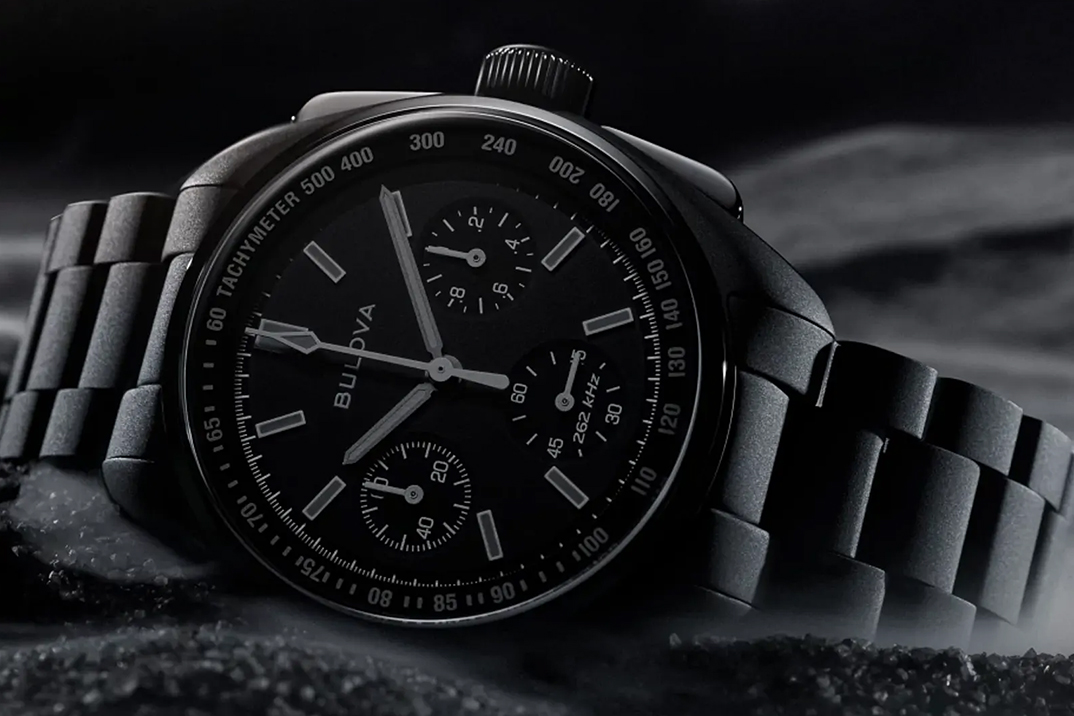
The sub-dial layout is the same three-register configuration found across the modern Lunar Pilot family: a 1/20th second chronograph counter at 3 o'clock, a running seconds sub-dial at 6 o'clock, and a 60-minute chronograph counter at 9. A gun-metal tachymeter scale runs around the inner edge of the bezel. Hands and applied indices are set in grey Super-LumiNova — a deliberately muted tone that maintains legibility without breaking the monochrome execution. When activated in darkness, the lume glow is blue, which adds a space-adjacent detail that works without feeling contrived. The screw-down caseback carries an individual series number and a glass insert depicting a matte black lunar landscape with Apollo 15 mission details engraved around the edge.
The NP20 Movement: High-Precision Quartz with a Real Case for It
Inside the Bulova Lunar Pilot Black Hole sits the brand's proprietary Caliber NP20, a high-precision quartz movement operating at 262,144 Hz — eight times the frequency of a standard 32,768 Hz quartz. That higher frequency has two practical consequences. First, the chronograph seconds hand sweeps continuously rather than jumping in discrete steps, which makes the Lunar Pilot feel mechanical to use even when it isn't. Second, accuracy is dramatically improved: the NP20 is rated to within one minute per year, compared to standard quartz at ±15 seconds per month.
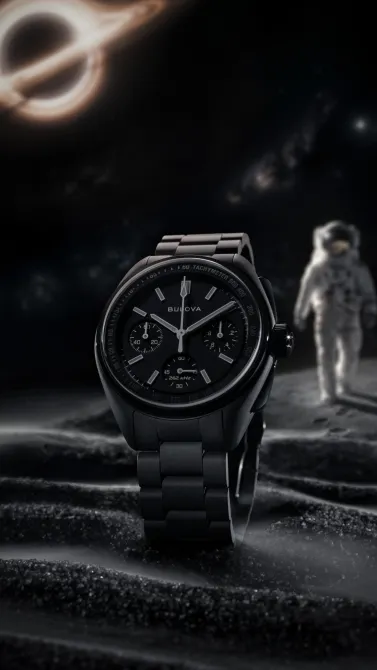
The 1/20th second chronograph precision matters in the context of what the original watch was used for: timing critical life-support parameters where seconds mattered. Bulova leans into this with the sub-dial at 3 o'clock, where the 10-unit scale around the register represents tenths of a second, allowing the wearer to read timing data to the nearest 0.05 seconds. It's a level of precision most mechanical chronographs cannot approach.
The question of whether high-precision quartz is a compromise or a feature genuinely depends on what you're buying the watch for. For those who want the most accurate possible instrument in a tool-watch format, the NP20 is not a concession. For those who prefer mechanical watchmaking at all price points, the Bulova Lunar Pilot Black Hole is probably the wrong watch regardless of other merits.
Bulova Lunar Pilot Black Hole: Full Specs
Reference: 98A335
Case diameter: 41mm
Case height: 13.05mm
Lug-to-lug: 48mm
Lug width: 20mm
Case material: Stainless steel with black PVD ion plating
Case finish: Sandblasted matte (case) + polished (bezel, pushers)
Crystal: Flat sapphire with 5-layer anti-reflective coating
Caseback: Screw-down with glass insert — lunar landscape, Apollo 15 details, individual series number
Water resistance: 100m (10 bar)
Dial: Musou Black paint — 99.4% light absorption
Dial accent: Gun-metal tachymeter scale
Sub-dials: 1/20s chrono counter (3); running seconds (6); 60-min chrono counter (9)
Hands/indices: Grey Super-LumiNova (blue glow)
Movement: Bulova Caliber NP20 High-Precision Quartz
Frequency: 262,144 Hz (8× standard quartz)
Chronograph precision: 1/20th second
Accuracy: Within 1 minute per year
Bracelet: Three-link black PVD stainless steel (sandblasted matte outer + polished centre links)
Clasp: Push-button butterfly deployant with Bulova tuning fork logo
Quick release: Yes
Limited edition: 6,000 pieces
Box contents: Special "Black Hole" box, travel pouch, Apollo 15-inspired desk clock
Price (US): $1,650
Price (UK): £1,250
Available: From April 28, 2026 at Bulova.com
How Much Does the Bulova Lunar Pilot Black Hole Cost?
The Bulova Lunar Pilot Black Hole is priced at $1,650 in the US and £1,250 in the UK. That is roughly double the price of older standard Lunar Pilot references, which collectors can find in the $700–$900 range. The premium reflects three specific additions: the full black PVD treatment across every surface (a significantly more labour-intensive finishing process than standard steel), the Musou Black dial coating, and the limited-edition packaging set. The NP20 movement is shared with non-limited Lunar Pilot references, so no premium applies there.
For comparison, the 43.5mm Bulova Lunar Pilot with Timascus dial (ref. 98A329), released as a 150th-anniversary edition, was priced identically at $1,650 — suggesting Bulova has anchored its premium limited-edition Lunar Pilot tier at this level deliberately.
The Special Edition Box Set
Included with the Bulova Lunar Pilot Black Hole is a box set that extends the Apollo 15 concept beyond the watch itself. The main box is themed around the "Black Hole" concept — dark, space-adjacent, and substantial enough to serve as a display case. Inside sits a matching travel pouch in the same black finish, and a desk clock directly inspired by the instrument timers used in the Apollo 15 lunar module capsule. The desk clock shares the same high-precision quartz technology as the watch's NP20 movement. It's a genuinely considered package rather than afterthought accessories, and for collectors who buy box sets as part of the proposition, it adds meaningful value above the watch alone.
Frequently Asked Questions
Q1. What is the Bulova Lunar Pilot Black Hole?
The Bulova Lunar Pilot Black Hole (ref. 98A335) is a limited-edition chronograph — the first Lunar Pilot ever produced in a 41mm case — featuring a Musou Black dial that absorbs 99.4% of visible light. It is limited to 6,000 pieces and priced at $1,650.
Q2, How much does the Bulova Lunar Pilot Black Hole cost?
$1,650 in the US and £1,250 in the UK.
Q3. Why is the Bulova Lunar Pilot Black Hole called "Black Hole"?
The name has two meanings: the Musou Black dial's near-total light absorption, and the "black hole" of suppressed information about Bulova's role in the Apollo 15 mission — when Commander David Scott's Bulova was used on the lunar surface in 1971, the brand name was redacted from all official documents for years.
Q4. Is the Bulova Lunar Pilot Black Hole quartz or mechanical?
It is powered by the Bulova NP20 high-precision quartz movement, operating at 262,144 Hz — eight times faster than standard quartz — offering 1/20th second chronograph precision and accuracy within one minute per year.
Q5. How many Bulova Lunar Pilot Black Hole watches were made?
6,000 pieces worldwide. (Note: the caseback engraving reads 5,000, but Bulova has confirmed that 6,000 pieces are being produced.)
Q6. What is Musou Black?
A specialty coating developed by Koyo Orient Japan that absorbs 99.4% of visible light, making a surface appear as a flat void rather than a physical object. It is used in stealth applications and high-contrast artistic installations.
The Bottom Line
The Bulova Lunar Pilot Black Hole gets two very different things right at once. It solves the Lunar Pilot's longstanding size complaint by bringing the case down to 41mm, which is what collectors have been asking for since the modern revival began. And it wraps that correction in a limited-edition visual concept — the Musou Black dial, the all-black PVD treatment, the Apollo 15 caseback — that is coherent and genuinely backed by the brand's history rather than retrofitted onto it. At $1,650, the Bulova Lunar Pilot Black Hole is not a budget chronograph any longer. But for a 41mm, 100m-rated, high-precision quartz space chronograph with a documented connection to lunar history and a Musou Black dial, it is a difficult thing to argue against.
For more on the Lunar Pilot's full history, Hodinkee's introducing article covers the backstory in depth. For more affordable space-themed watches to compare, see our space watches guide.