
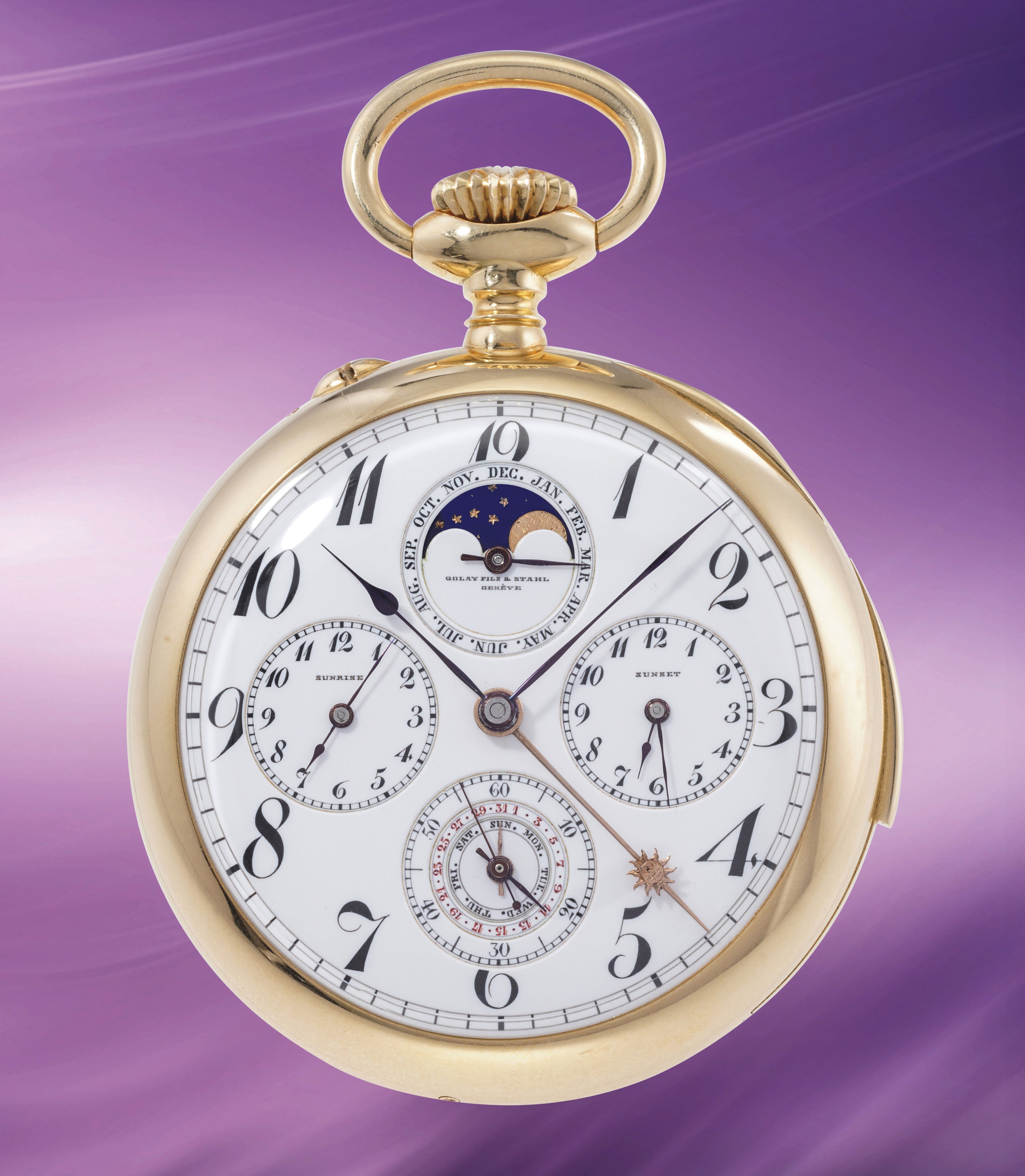
The Golay Fils & Stahl Maharaja Patiala pocket watch — a circa-1910 yellow gold grande complication built to the personal commission of Maharaja Bhupinder Singh, ruler of the princely state of Patiala — sold for CHF 647,700 at Phillips' Geneva Watch Auction XXIII on 9 May 2026, crushing its high pre-sale estimate of CHF 200,000 by more than three times. Offered as Lot 107, the 52mm 18k yellow gold openface timepiece carries five simultaneous complications: a minute repeater, a perpetual calendar with moonphase, an equation of time, and a sunrise-sunset mechanism calibrated permanently to the latitude of the city of Patiala itself. No other complication watch in recent Geneva auction history carries so direct a geographic signature.
For more from the intersection of Indian royal heritage and fine watchmaking, see our Indian royal watches archive. Here is the complete story of the Golay Fils & Stahl Maharaja Patiala pocket watch — what it is, who built it, who commissioned it, and what it sold for.
Who Commissioned the Golay Fils & Stahl Maharaja Patiala Pocket Watch?
Maharaja Bhupinder Singh (1891–1938) was the ruling Maharaja of Patiala — one of the largest Sikh princely states under British paramountcy in the Punjab — from 1900 until his death. He assumed full governing powers in 1910 and spent the next three decades establishing himself as the most recognisable Indian patron of European luxury the early twentieth century produced.
The statistics of his collecting are as specific as they are staggering. He owned 44 Rolls-Royces and is believed to have been the first person in India to own a private aircraft. He captained the Indian cricket team on its 1911 tour of England. He popularised what the subcontinent still calls the "Patiala peg." In 1928 he commissioned the Patiala Necklace from Cartier: a piece containing 2,930 diamonds, among them a 234-carat De Beers stone that was the seventh-largest diamond in the world.
His relationship with Swiss watchmaking was just as significant. In 1916, Vacheron Constantin created both a wristwatch bracelet and a dedicated pocket watch for him. In 1921, he visited the Vacheron Constantin store on the Rue des Moulins in Geneva, accompanied by two wives and a full entourage, and spent CHF 150,000 in a single afternoon — a sum equivalent to roughly CHF 700,000 today. The centrepiece was an 18ct gold pocket watch combining a minute repeater, chronograph, astronomical calendar, moonphase, and alarm. He also acquired a 1928 Cartier Tank à Guichet with jumping hours — one of the most avant-garde wristwatches of its era.
The Golay Fils & Stahl Maharaja Patiala pocket watch under discussion is, if anything, the most technically ambitious piece in that canon.
What Makes the Golay Fils & Stahl Maharaja Patiala Pocket Watch Extraordinary?
The five complications in this watch are not merely impressive on paper — each one carries a specific reason to exist. The minute repeater chimes hours, quarter-hours, and minutes on demand, a function designed for darkness or situations where reading the dial is impractical. The perpetual calendar with moonphase display accounts automatically for months of unequal length and leap years. These two are sophisticated but not unprecedented for the period.
The remaining three are where the Golay Fils & Stahl Maharaja Patiala pocket watch becomes genuinely unusual. The equation of time displays the difference between mean solar time — our conventional 24-hour civil clock — and true solar time, which varies continuously because of the earth's elliptical orbit. The equation of time hand carries a small engraved sun at its tip. It is a complication found on only a handful of watches from any era.
The sunrise-sunset mechanism goes further still. Unlike the equation of time, which can theoretically be built for any reference point, a sunrise-sunset complication must be permanently calibrated to a single latitude. This one was set for latitude 30.23 degrees North — the precise latitude of Patiala in the Punjab of Northern India. The mechanism cannot be repurposed for another city. It was an engineering commitment made specifically to one place on earth: the Maharaja's own kingdom.
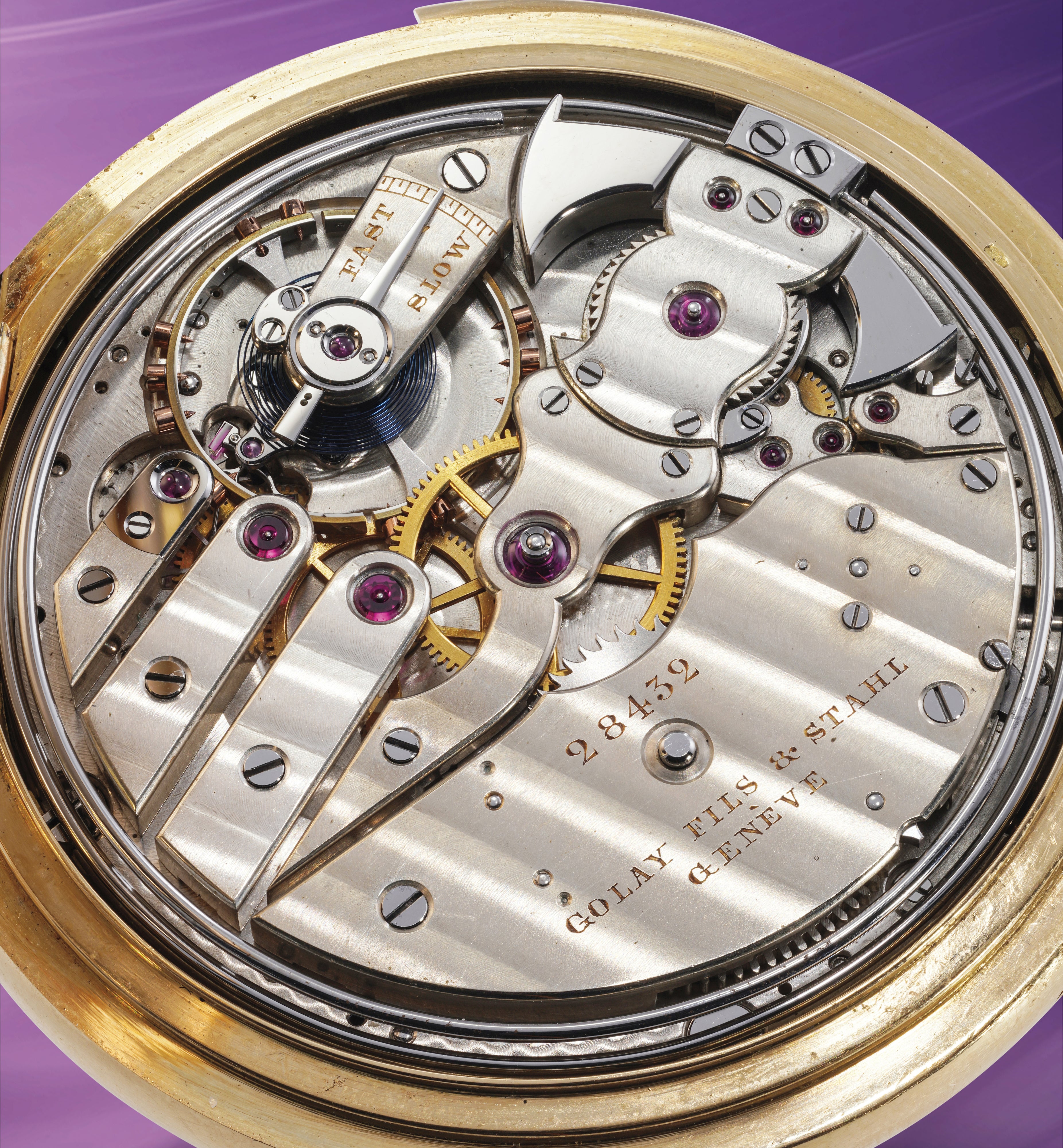
The Guillaume balance — a temperature-compensating oscillator of exceptional accuracy — and the wolf-tooth winding system complete the movement's technical credentials.
The Masters Behind the Movement
The Golay Fils & Stahl Maharaja Patiala pocket watch was not the work of a single atelier. The ébauche was made before the First World War by Leon Aubert of Le Brassus; the calendar mechanism by Paul-August Golay of the Vallée de Joux; and the sunrise-sunset mechanism by Jean Piguet, also of Le Brassus.
All three of these craftsmen also worked on the Patek Philippe Graves Supercomplication — the most complex pocket watch ever produced at the time of its 1933 completion. The hands that built the Maharaja's watch were the same hands that built the most celebrated grande complication of the twentieth century.
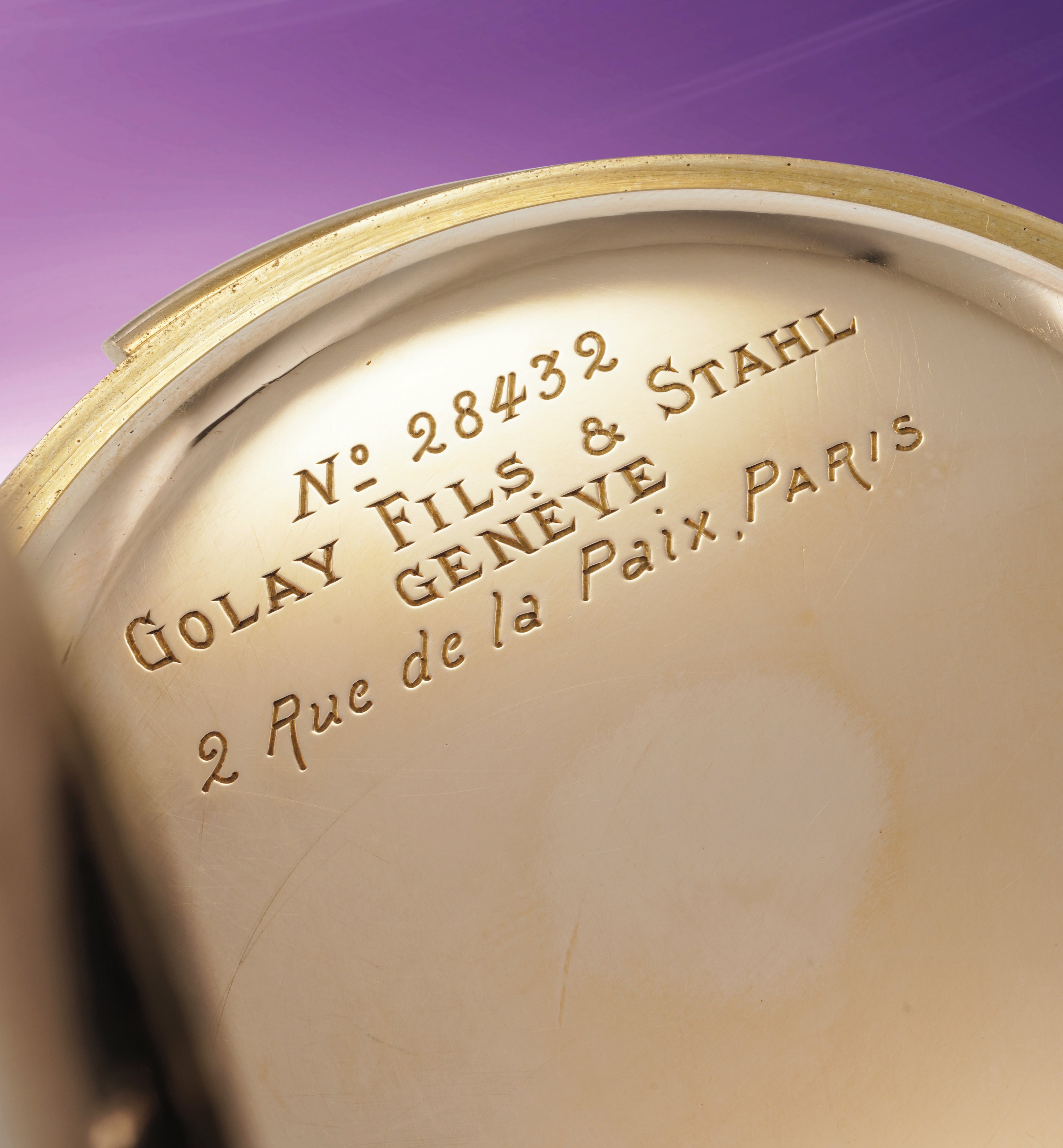
Golay Fils & Stahl was founded in Geneva in 1837 by Auguste Golay Leresche. The company still operates today — but now as a jeweller, not a watchmaker. The Golay Fils & Stahl Maharaja Patiala pocket watch is therefore an artefact from the firm's horological period, a period that has long since closed.
Golay Fils & Stahl Maharaja Patiala Pocket Watch: Key Details
Maker: Golay Fils & Stahl, Geneva
Year: Circa 1910
Phillips lot: 107, Geneva Watch Auction XXIII, 9–10 May 2026
Case: 18k yellow gold, openface, 52mm diameter
Movement: Manual winding, 31 jewels, signed on case, dial and movement
Movement number: 28'432
Complications: Minute repeating, perpetual calendar, moonphase, equation of time, sunrise-sunset
Sunrise-sunset latitude: 30.23°N — Patiala, Punjab, India
Balance: Guillaume (temperature-compensating)
Winding: Wolf-tooth system
Ébauche: Leon Aubert, Le Brassus
Calendar mechanism: Paul-August Golay, Vallée de Joux
Sunrise-sunset mechanism: Jean Piguet, Le Brassus
Pre-sale estimate: CHF 100,000–200,000 (approx. ₹1.2–2.4 crore)
Sold for: CHF 647,700 (approx. ₹6.1 crore at June 2026 rates)
The CHF 647,700 Auction Result
The Golay Fils & Stahl Maharaja Patiala pocket watch carried a pre-sale estimate of CHF 100,000–200,000. It sold for CHF 647,700 — more than three times its upper estimate, and approximately ₹6.1 crore at June 2026 exchange rates. The result is one of the strongest single-lot performances of the entire Phillips Geneva Watch Auction XXIII sale and places this piece among the most valuable Indian royal-provenance timepieces to appear at auction in recent years.
The premium is not difficult to explain. Provenance to Maharaja Bhupinder Singh, when documented in original commission records, consistently multiplies realisable value. In this case, the provenance is built into the mechanism itself: the sunrise-sunset calibration to latitude 30.23°N cannot be altered or removed. The watch is self-authenticating in a way that no certificate alone could achieve.
For the full Phillips lot record, see the official Phillips auction listing. For more results from the same sale, visit our watch auction coverage.
Frequently Asked Questions
Q1. How much did the Golay Fils & Stahl Maharaja Patiala pocket watch sell for?
CHF 647,700 at Phillips' Geneva Watch Auction XXIII on 9 May 2026 — approximately ₹6.1 crore at June 2026 exchange rates. Its high pre-sale estimate was CHF 200,000.
Q2. What complications does the Golay Fils & Stahl Maharaja Patiala pocket watch have?
Five: minute repeating, perpetual calendar with moonphase, equation of time, and a sunrise-sunset mechanism permanently calibrated to latitude 30.23°N — the latitude of Patiala, Punjab.
Q3. Who made the movement inside the Golay Fils & Stahl Maharaja Patiala pocket watch?
The ébauche by Leon Aubert of Le Brassus; the calendar by Paul-August Golay of the Vallée de Joux; the sunrise-sunset by Jean Piguet of Le Brassus. All three also worked on the Patek Philippe Graves Supercomplication.
Q4. Who commissioned this watch?
Maharaja Bhupinder Singh of Patiala (1891–1938), the ruling Maharaja of the Sikh princely state of Patiala, one of the most prolific royal patrons of European luxury in the early twentieth century.
Q5. Why did it sell for so much above estimate?
The combination of Maharaja Bhupinder Singh's documented provenance, the rarity of the five-complication configuration, and — crucially — the sunrise-sunset mechanism calibrated specifically to Patiala's latitude. That calibration is an unremovable authentication built into the engineering itself.
Q6. Does Golay Fils & Stahl still make watches?
No. The firm was founded in 1837 and still operates in Geneva today, but now exclusively as a jeweller.
The Bottom Line
The Golay Fils & Stahl Maharaja Patiala pocket watch is one of those auction results that clarifies exactly what the market values most: specificity, provenance, and engineering that cannot be faked. A sunrise-sunset mechanism set to latitude 30.23°N tells you precisely where this watch was meant to be worn and by whom. Three centuries of Swiss watchmaking tradition, and these craftsmen used it to encode the coordinates of a Punjabi kingdom into a 52mm gold case. At CHF 647,700 — almost ₹6.2 crore — the bidders understood that. For further reading on Indian royal horological patronage, WatchTime India's archive is the most thorough resource available.
Which Indian royal watch commission would you most like to see surface at auction next? Let us know in the comments and subscribe for more from the world's most important watch auctions.