
Some watches demand your attention. The Girard-Perregaux Laureato has never been one of them. For fifty years it has made its case quietly, happy to sit alongside the icons it launched with rather than shout over them. The model turned fifty in 2025, and instead of marking it with one big statement piece, Girard-Perregaux split the celebration in two: a precious two-tone limited edition late last year, then a run of steel anniversary watches arriving in boutiques in June 2026. Both say something about what the Laureato has always been, which is measured, nicely proportioned and a little understated.
A child of the 1970s
You can't really explain the Laureato without going back to the decade that produced it. The 1970s were a turbulent time for Swiss watchmaking. Quartz had arrived and looked capable of wiping out the mechanical watch altogether, and Girard-Perregaux was right in the middle of it. The Manufacture built its own quartz calibre, the GP 350, and it was the first to run at 32,768 Hz, the frequency that went on to become the industry standard and is still used in quartz watches today. This was a company that preferred to push rather than follow.
That same decade produced another idea that proved just as durable: the integrated luxury sports watch. The recipe looked simple. Take a sporty watch, make it unmistakably luxurious, give it an integrated bracelet and a slim movement. Audemars Piguet and Gérald Genta set the template with the Royal Oak in 1972, and Patek Philippe followed with the Nautilus in 1976. The Girard-Perregaux Laureato arrived in 1975, right between the two. It was an early example of the genre, not a copy of it.
The Laureato also wasn't drawn by a famous name. Girard-Perregaux has since put to rest the old rumour that Italian architect Adolfo Natalini designed it. The real credit goes to an in-house designer who stayed anonymous, which was unusual at a time when a designer's signature had started to sell watches. The name took a while to stick, too. "Laureato" is Italian for "graduate," and while Italian ads used it from the start, it wasn't engraved on the watch until the 1990s. For years the piece was known only by its reference number, or by the rather flat label Quartz Chronometer.
Five decades, one silhouette
For all that history, the striking thing about the Girard-Perregaux Laureato is how little its core has changed. Three elements have stayed constant through every generation: an octagonal bezel sitting on a round base, a tonneau-shaped case, and an integrated bracelet. Everything else has been built around those three.
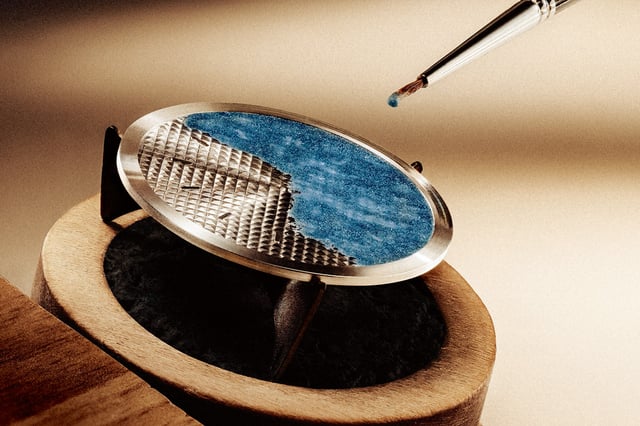
The design codes that have defined the Laureato since 1975: an octagonal bezel on a circular base, a tonneau case and an integrated bracelet.
The second generation came in 1984 with a reworked bracelet and an added mid-link. The third, in 1995, was Gino Macaluso's redesign. Macaluso had taken over the La Chaux-de-Fonds Manufacture, and he brought the Laureato back to mechanical power with the in-house ultra-thin automatic Calibre 3000. That mattered at a moment when hardly anyone was still making mechanical movements. The 2003 "Evo3" generation grew bigger and sportier. Then in 2016 the Laureato was reborn. That version returned to the watch's original codes, came in several sizes and complications, and landed just as collectors were rediscovering integrated sports watches. It sold well, and it gave the line real momentum again.
The anniversary watches pick up from that 2016 design. They refine it rather than reinvent it.
Act one: the Laureato Fifty
The first of the anniversary watches is called the Laureato Fifty. It's a 200-piece limited edition that goes back to the very first two-tone Girard-Perregaux Laureato. The case is new and compact, 39mm wide and 9.8mm thick. The clever bit is how that thickness is handled. The case middle measures only about 5mm and sits between the bezel and the caseback, so on the wrist the watch looks slimmer than the spec sheet suggests. It's made in steel and 3N yellow gold, the octagonal bezel has been reworked with a mix of satin and polished surfaces, and water resistance is now a useful 150 metres.
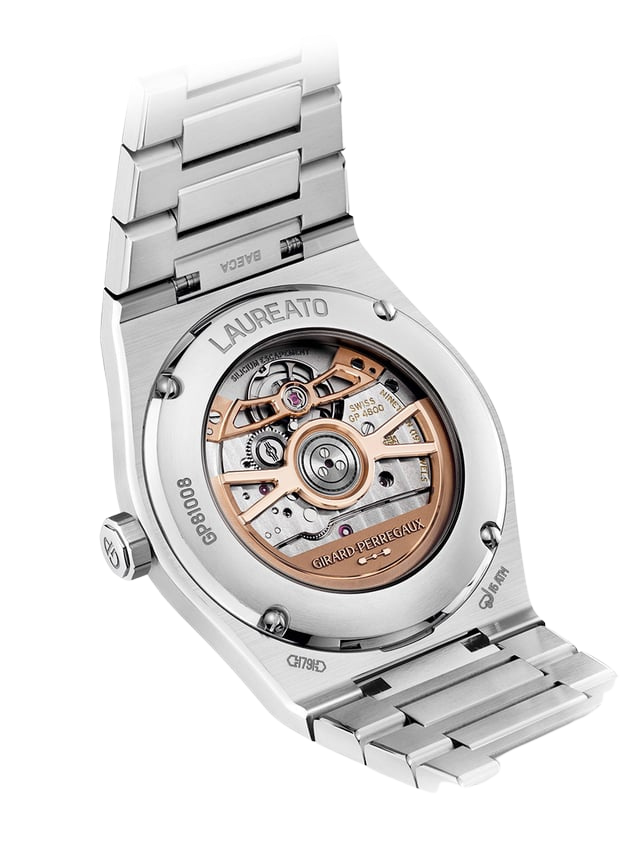
The Laureato Fifty limited edition in steel and 3N yellow gold, with its sunray grey Clous de Paris dial.
The dial is a deep sunray grey with the Laureato's usual Clous de Paris (hobnail) pattern, given a touch more relief this time. The gold indexes and baton hands match the case, a double index sits where the GP logo normally would at twelve o'clock, and the central seconds hand carries the brand's double-arrow counterweight. The bracelet has been tweaked as well, with shorter and more domed central links, a clasp engraved with the GP logo, and a fine-adjustment system that gives you up to 4mm of play on the wrist.
The best part is on the back. Through the sapphire caseback you get the new Calibre GP4800, and it's a real step up. It runs a silicon escapement, a variable-inertia balance, ceramic ball bearings, a 28,800 vph beat and roughly 55 hours of power reserve. It's also the first time Girard-Perregaux has used its Three Bridges architecture on a simple hours, minutes, seconds and date movement, rather than saving it for the tourbillons. The openworked rotor even carries arrow motifs that nod to those tourbillons. The price is CHF 25,000, and the reference is 81008-63-3412-1CM.
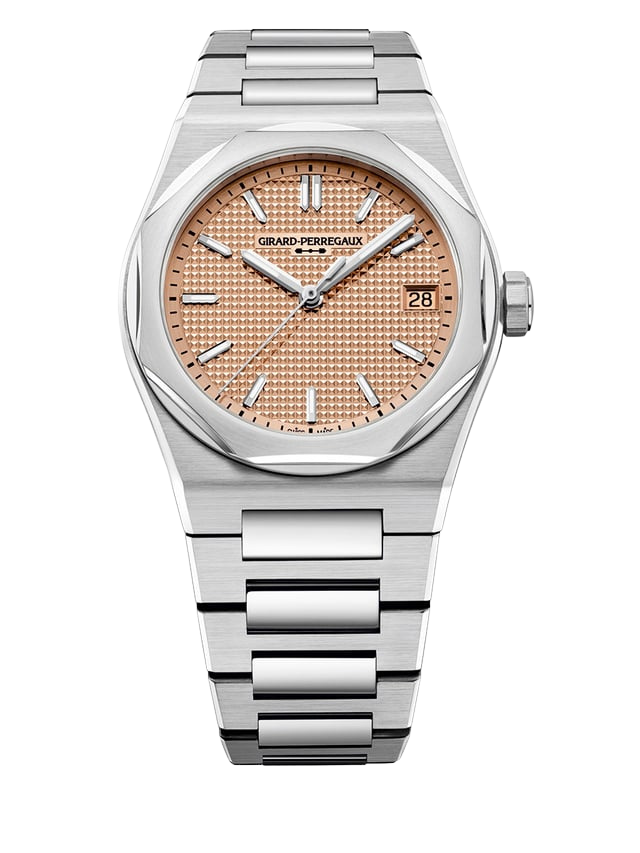
The new Calibre GP4800, with a Three Bridges-inspired architecture visible through the sapphire caseback.
Act two: four steel Selfwinding models
If the gold Fifty was the formal opening, this is the part most people will actually buy. The Laureato Fifty Selfwinding collection lands in June 2026 with four stainless-steel references in two sizes, and the focus this time is on the dials and the proportions.
The standout is a 39mm version with a blue enamel dial. It's the first Girard-Perregaux Laureato to wear translucent enamel over the Clous de Paris texture, and because it's made in-house, it has a depth and a shifting quality you'd usually find on a dress watch, not a sports one. A second 39mm reference drops the enamel for an 18-karat solid-gold dial with the same hobnail pattern, and adds a date window at three o'clock that has been colour-matched to the dial.
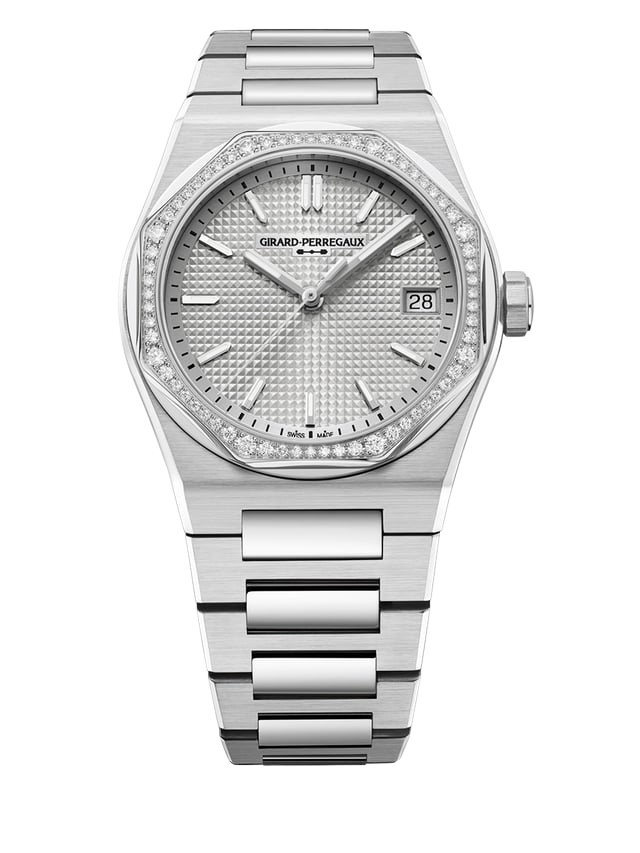
One of the four steel Laureato Fifty Selfwinding references, arriving June 2026 with elevated dial craft.
The real talking point, though, is the size. For the first time in this generation there's a 36mm case, and Girard-Perregaux is careful to frame it not as the small option but as a return to the proportions of the original. One 36mm model gets the gold dial. The other pairs a silver-toned Clous de Paris dial with a bezel set with 64 brilliant-cut diamonds, around 0.55 carats in total.
All four run the GP4800, this time with a rose-gold balance bridge that's exclusive to the anniversary collection and adds a little warmth to an otherwise monochrome movement. The steel versions are listed at 4 Hz with a 60-hour power reserve, the same 9.8mm height, 150 metres of water resistance and the same micro-adjust clasp. Prices sit between about €22,400 and €23,800, or roughly $26,000 to $27,700, which puts them just under the gold limited edition.
Why the Girard-Perregaux Laureato anniversary lands
Girard-Perregaux could have marked fifty years with one loud showpiece and left it there. Splitting the celebration feels truer to the watch. The gold Fifty pays its respects to the 1975 original, while the steel four bring things people will actually wear: a smaller case, an enamel dial, a better movement. Fifty years on, the Girard-Perregaux Laureato is still doing what it does best, changing a great deal under the surface while looking almost exactly the same on top.
An Indian angle
For buyers in India, the Laureato sits in an interesting spot. The integrated luxury sports watch conversation here still revolves around the Royal Oak and the Nautilus, and so do the waiting lists. That's exactly why the Girard-Perregaux Laureato is worth a look. You get the same design language and a serious in-house movement, usually with far better availability and none of the speculative madness that makes its rivals so hard to buy. As the Indian luxury watch market grows past the obvious names, watches like the Laureato Fifty, and especially the more wearable 36mm steel models, are the kind of thoughtful pick that suits a second or third watch. If you're building a collection rather than chasing a flip, this is one to keep an eye on.
Girard-Perregaux Laureato Fifty: key specifications
Laureato Fifty (limited edition)
- Case material: Steel and 3N yellow gold
- Diameter: 39mm
- Thickness: 9.8mm
- Water resistance: 150m
- Dial: Sunray grey, Clous de Paris
- Movement: Calibre GP4800, automatic
- Power reserve: About 55 hours
- Reference: 81008-63-3412-1CM
- Availability: Limited to 200 pieces
- Price: CHF 25,000
Laureato Fifty Selfwinding (steel collection)
- Case material: Stainless steel
- Diameter: 39mm and 36mm
- Thickness: 9.8mm
- Water resistance: 150m
- Dial: Blue enamel / 18k gold / silver-toned (diamond bezel option)
- Movement: Calibre GP4800 with rose-gold balance bridge
- Power reserve: About 60 hours
- References: 81008-11-3627-1CM, 81008-11-3530-1CM, 81006-11-3626-1CM, 81006-11S3597-1CM
- Availability: From June 2026
- Price: About €22,400 to €23,800
Sources: Girard-Perregaux, Monochrome Watches, WatchTime, Bucherer.